

Punt Builds, Explained: the 6 strategies that win categories
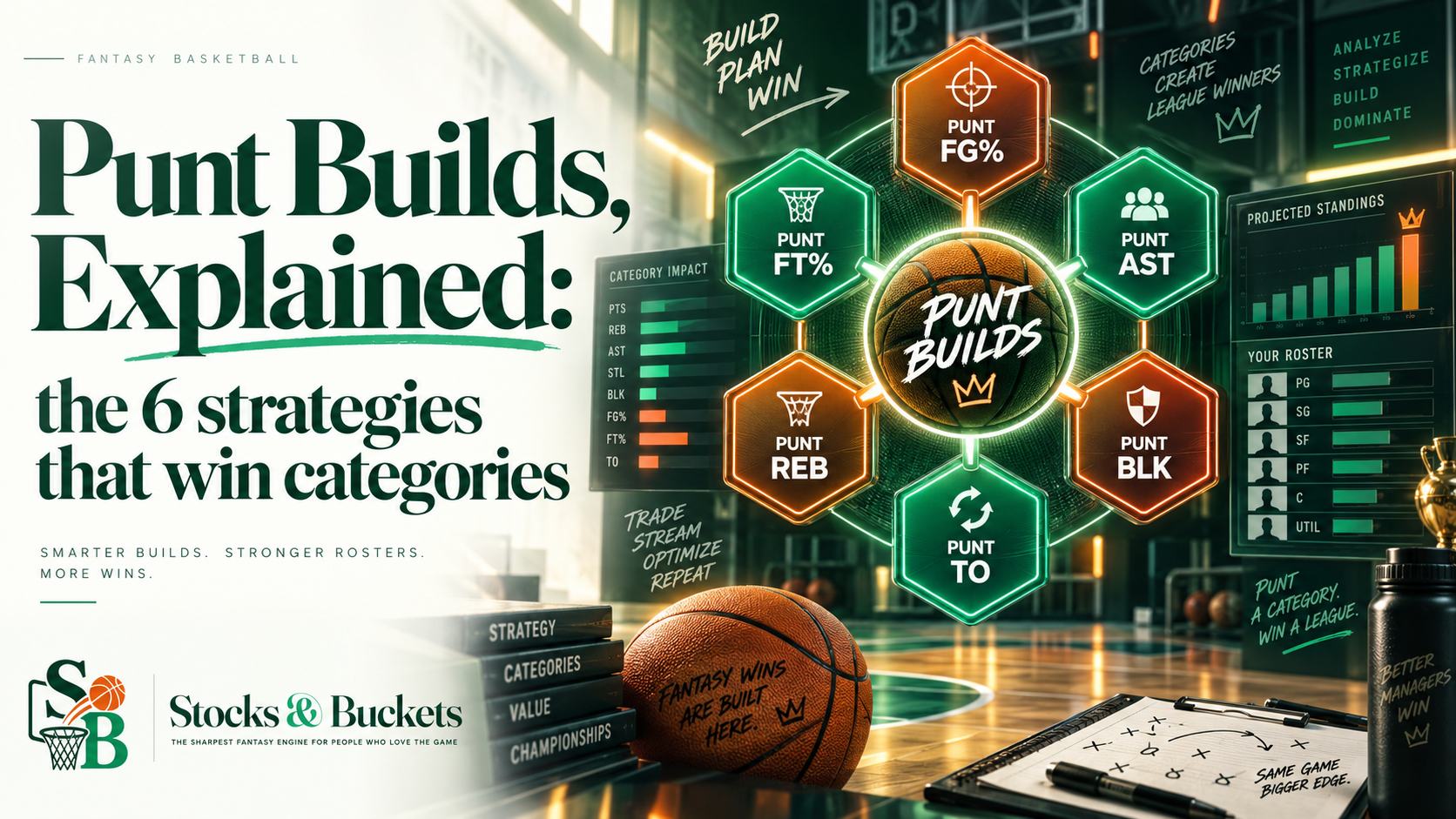
Punting isn't giving up — it's how category leagues are actually won. Here's what a punt build is, why it works, and the six builds (punt FT%, FG%, assists, turnovers, threes, blocks) with the anchor players to draft around each.

If you've spent any time in a fantasy basketball group chat, you've heard someone say they're "punting free throws." And if you're newer to this, that probably sounded like a mistake — why would you give away a category on purpose?
Here's the thing: in a category league, deliberately conceding one category is often the sharpest move on the board. Not a white flag — a plan. Punting is how good managers turn a roster full of flawed players into a team that wins its matchups every week. Let's break down what it actually means, why it works, and the six builds worth knowing cold before your draft.
What "punting" actually means
In a 9-category league you're graded on nine stats: field-goal %, free-throw %, three-pointers, points, rebounds, assists, steals, blocks, and turnovers. Here's the part that unlocks everything: you win or lose each category separately. Crushing rebounds by a mile earns you exactly the same one point as winning it by a single board. Effort you pour into a category you're already dominating is wasted.
Punting takes that logic and runs with it. You pick one category you're going to stop caring about — and in exchange, you get to draft players other managers are scared of, at a discount, and stack the eight categories that still count. You're not trying to go 9-for-9. You're trying to reliably win 5 or 6, which is all it takes.
A quick, concrete example. Free-throw percentage is the classic punt. The moment you decide you don't care about it, a whole tier of dominant big men — guys who bludgeon you at the line but win rebounds, blocks, and field-goal % single-handedly — go from "roster poison" to "your best picks." Everyone else is passing on them. You're not. That's the edge.
Why it works (and when it doesn't)
Punting works because elite production is lumpy. The best real-life players are rarely well-rounded fantasy assets — their greatness comes with a glaring hole. Giannis Antetokounmpo is a top-5 talent who can sink your free-throw percentage all by himself. A punt is just a decision to stop paying the tax for holes you were never going to fix anyway, and to collect the ones that line up.
Two schools of thought: commit early, or let it come to you
Before we get to the builds, know that managers split into two camps on how to punt — and both win titles:
- School A — commit early. You decide your punt before the draft (or on the clock in round one) and target it deliberately, scooping up the discounted players your build loves while everyone else hesitates. Highest reward, because you squeeze the most value out of the punt — but you're locked in, so a run on your archetype can force you into a reach.
- School B — best player available, then punt. You just take the best players on the board for the first few rounds, watch which weakness keeps repeating, and then formalize the punt your roster is already pointing at. More flexible and more forgiving for newer managers — you rarely reach. The tradeoff is you capture a little less of the discount because you committed later.
There's no wrong answer here; it's a risk-versus-flexibility call, and sharp managers do both depending on how the board falls. What both camps agree on is the one hard rule: don't punt two categories that fight each other. Punt free-throw % and points, for instance, and you've kneecapped your own scoring while chasing bigs. Concede one category, and let the other eight reinforce each other.
A quick note on format: punting is stronger in head-to-head than in season-long roto, because in H2H you only need to win a category this week, not run up the season-long score. But the core idea travels to both.
The 6 builds worth knowing
Here's the map. Each of these deserves its own deep dive — the exact anchors, the mid-round targets, the waiver-wire types that fit, and how to pivot when it goes wrong — and we'll give every one of them a dedicated breakdown in the weeks ahead. Consider this the overview that ties them together.
1. Punt FT% — the beginner's best friend
You concede: free-throw percentage. You dominate: FG%, rebounds, blocks, and often points. Anchor types: elite, high-volume bigs who brick free throws. Think Giannis Antetokounmpo, Rudy Gobert, and Walker Kessler.
This is the most popular punt for a reason: the players it unlocks are genuinely great, and the fantasy market systematically overrates free-throw %. Draft one bad-FT superstar big, then keep stacking centers everyone else is avoiding. It's the easiest build to learn because the pieces are obvious and the category you're giving up is the one casual managers cling to hardest.
2. Punt FG% — the sharpshooter's build
You concede: field-goal percentage. You dominate: threes, free-throw %, assists, steals, points. Anchor types: high-usage guards who chuck and rack up counting stats — James Harden, Trae Young.
The mirror image of punt FT%. Once you stop caring about efficiency, you get to roster every volume scorer and three-point specialist on the board — the guys who fire 20 shots, miss half, and don't care. You'll bury opponents in threes, dimes, and free-throw %, and the ugly field-goal number simply doesn't matter to you.
3. Punt Assists — the wing-and-big build
You concede: assists. You dominate: FG%, rebounds, blocks, steals, and often points. Anchor types: bigs and non-passing wings who fill everything except the assist column.
This one lets you sidestep the ball-dominant guards entirely and load up on switchable wings and rim-runners. It pairs beautifully with defensive stats — a lot of great non-passers rack up steals and blocks. The catch: it can drag your points and threes if you go too big, so keep a scorer or two in the mix.
4. Punt Turnovers — the "draft every star" cheat code
You concede: turnovers. You dominate: everything the stars give you. Anchor types: ball-dominant superstars who cough it up because they touch it constantly — Nikola Jokic, Shai Gilgeous-Alexander, James Harden.
Turnovers are the tax you pay for usage. Punt them, and you can chase every high-usage engine on the board without flinching at the giveaways. It's the least "sacrificial" punt — you're not really building around a weakness so much as refusing to pay a tax on greatness. (We wrote more about why turnovers are a usage signal, not a character flaw in our methodology.)
5. Punt 3PM — the center-heavy hammer
You concede: three-pointers. You dominate: FG%, rebounds, blocks, steals. Anchor types: rim-running bigs and slashers who never step out to the arc.
Less common, but brutal when your league sleeps on it. If your core is Rudy Gobert and Walker Kessler-type centers, you were never winning threes anyway — so formalize it, punt the category, and turn the paint into a fortress across FG%, boards, and blocks.
6. Punt Blocks — the guard-heavy build
You concede: blocks. You dominate: assists, steals, threes, FT%, points. Anchor types: guards and perimeter scorers, top to bottom — an Anthony Edwards-style backcourt build.
Blocks are the most concentrated category in fantasy — a tiny handful of bigs supply most of them. If you're loading up on guards and wings, you're punting blocks whether you admit it or not. Own it, skip the shot-blocking specialists, and win the five or six perimeter-friendly categories in a walk.
How to actually run one
If you're the plan-ahead type (School A), pick your punt, find the anchors above, and go get them. If you'd rather stay flexible (School B), the move is even simpler: take the best player available, notice which flaw keeps showing up, and lean into it. If your first three picks all brick free throws, congratulations — you're punting FT%, so stop drafting good free-throw shooters and start collecting the bigs everyone else is scared of.
That's exactly where our board is built to help. Every player carries a value that already accounts for the category math — our variance-adjusted G-score — plus a punt-fit read, so you can see at a glance who slots into which build instead of eyeballing it. We do the sorting; you make the call. (New here? Here's who we are and why we do it this way.)
Punting isn't the only way to win — a balanced build can absolutely take a title. But knowing these six cold means you'll never panic when your draft goes sideways, because a "messy" roster is usually just a punt you haven't named yet. Name it, commit, and go win your league.
New analysis, every week.
Our sharpest reads and the views we'd act on, plus early access to the tools.
Join us