

10 Beginner Fantasy Basketball Mistakes (and Their Fixes)
Ten mistakes that quietly cost beginners their fantasy basketball leagues — and the sharp habit that replaces each one. The fast lane past year-one errors.

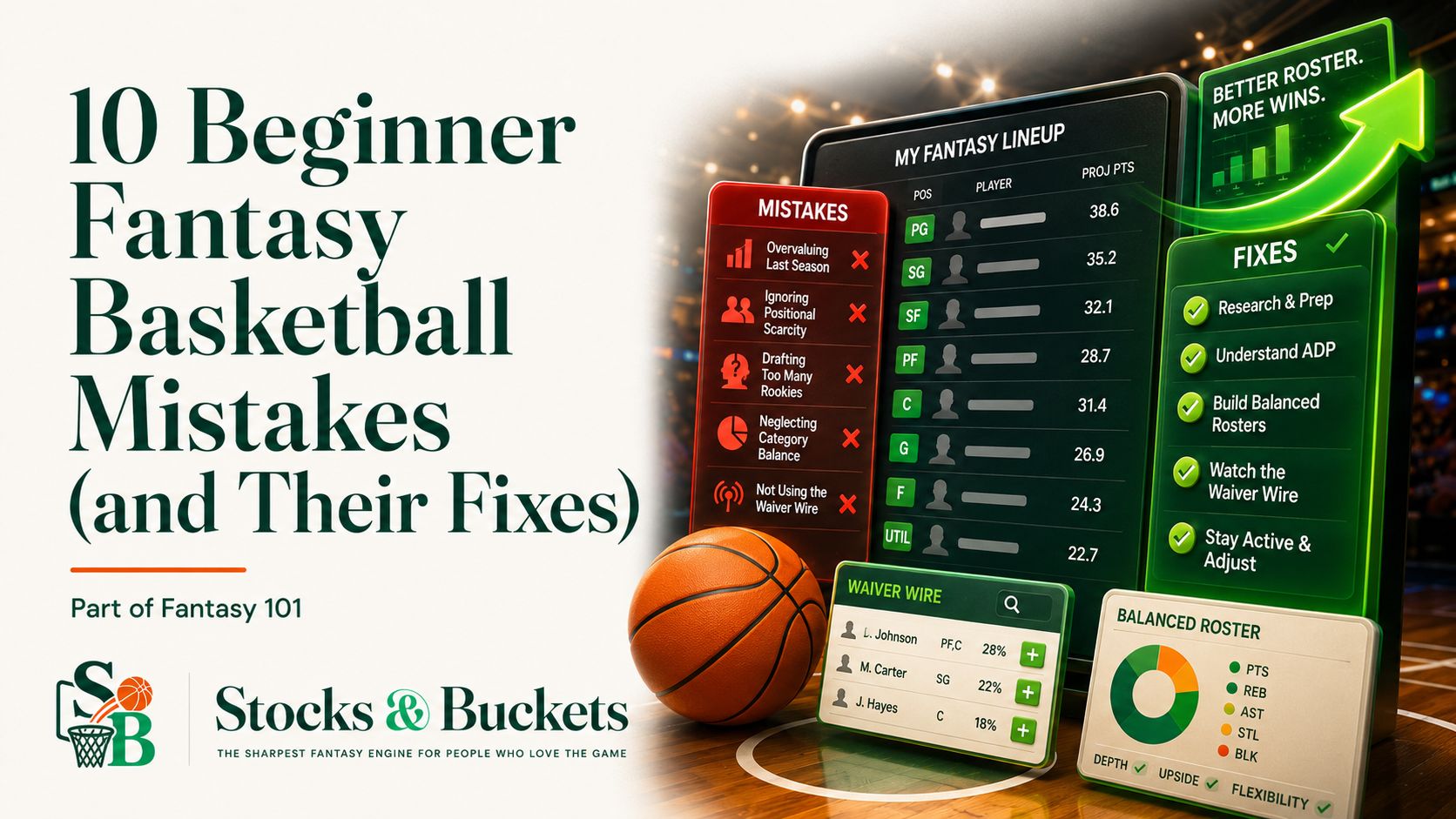
Part of Fantasy 101 — our from-scratch guide to fantasy basketball. The series so far: what fantasy basketball is, scoring formats, your first draft, running your lineup, the in-season playbook, and winning your matchup.
Every one of these mistakes is normal. We've made all ten, some of them repeatedly, one of them in a championship week we still don't discuss. But here's the encouraging math: beginner leagues aren't won by brilliance — they're won by not donating wins through a handful of predictable errors. Skip these ten and you're instantly playing above the median. For each one: the mistake, why it happens, and the sharp habit that replaces it.
1. Drafting last season's box scores
The most expensive mistake in fantasy, and the most human: treating what a player did as what he'll do. Last season already happened — you're drafting next season. Players age, roles change, teammates arrive and leave, and hot shooting cools. The market (your league) prices players on memory; the edge is pricing them on projection — a forecast that weighs age, role, minutes, and sustainability, which is literally how our board is built.
The sharp habit: before nominating any pick, ask "what's his situation this season?" If you can't answer, that's what the player pages are for — every name carries our written view on exactly this question.
2. Ignoring games played
Beginners draft talent. Winners draft talent multiplied by availability. A superstar who plays 55 games gives you 55 games of stats and 27 nights of zeroes — and in most formats, the zeroes are quietly lethal. This is the single most mispriced factor in casual drafts, because highlight reels don't show the nights a player sat. When we project someone like Jayson Tatum coming off a major injury, the expected-games number moves his draft value more than any skill argument — a top-12 talent can be a round-3 pick, and both halves of that sentence are true at once.
The sharp habit: every draft pick, glance at two numbers: the per-game value and the games estimate. You're buying the product of the two.
3. Treating all 20-point scorers as equals
In category leagues, the box-score headline hides the fantasy reality: shape matters more than size. Twenty points on 51% shooting with threes and steals is a franchise cornerstone; twenty points on 42% shooting with 76% free throws and four turnovers is — genuinely — a player who can lower your win rate while looking great doing it. The percentage categories and turnovers are where famous names go to hurt you.
The sharp habit: read a player's full category line before falling in love. A big man's free-throw percentage (Jalen Duren-shaped players, we're looking at you) or a star's turnovers are part of his price. This is also the doorway to punting — deliberately conceding a category to dominate the rest — which stops being an advanced trick and starts being obvious the moment you think in categories. Our full punt-builds guide lands later this week.
4. Setting your lineup on Monday and walking away
The NBA schedule doesn't respect your calendar. Players rest, tweak ankles, and get ruled out an hour before tip — and every empty starting slot is a stat line you paid for and didn't collect. Over a season, forgotten lineups cost most beginners more value than any bad draft pick.
The sharp habit: the two-minute pre-tip check, every game night. Injured or idle players out, live bodies in. If your league locks lineups weekly instead of daily, do the Sunday schedule session religiously — it's your only lever.
5. Never touching the waiver wire
In every beginner league there's a manager whose roster on the last day is identical to draft night. That manager finishes eighth. Rotations change constantly — injuries open thirty-minute roles, coaches fall in and out of love with players, rookies arrive mid-season — and all of that value lands in the free-agent pool first. The wire is not a repair shop for injuries; it's a season-long shopping street.
The sharp habit: scan free agents twice a week with one question: whose minutes just changed? Minutes are the leading indicator; the box score follows.
6. Confusing a hot week with a new reality
The opposite failure mode of mistake 5: chasing every stranger who scored 22 last night. Most hot streaks are noise. What you're hunting is a role change — the difference between a bench player who made shots for a week and a player who's suddenly starting. One reverts; the other compounds.
The sharp habit: before any pickup, check the why. New starter, injury ahead of him, minutes trending up = signal. Same 18-minute role, unsustainable shooting = bait. (And when it's genuinely unclear, that's exactly the kind of call our per-player views exist to make for you.)
7. Panic-trading in November
Your second-round pick is averaging six fewer points than last year, someone in the chat calls him washed, and by Thanksgiving you've swapped him for sixty cents on the dollar. Early-season slumps from established players with intact roles are discounts, not verdicts — and the manager who buys them (a slow-starting Stephen Curry month has minted more league titles than it's cost) is usually collecting a top-20 asset at a top-40 price.
The sharp habit: before selling any slumper, check the two things that predict recovery: minutes and role. Intact? Hold, or better, buy the other guy's. Changed? Now it's a real conversation.
8. Building a roster with no plan
Thirteen individually reasonable picks can add up to a team that loses six categories every single week — four point guards, no rebounds, a punt in three directions at once by accident. A fantasy roster isn't a collection; it's a construction. Every category league rewards managers who know what their team is trying to be good at.
The sharp habit: from mid-draft onward, keep a running tally of your build: which categories you're strong in, which you've conceded, which are contested. In-season, every waiver claim and trade either serves the build or it doesn't. "Best player available" is a draft-round-one idea, not a February one.
9. Quitting in December
Half of beginner leagues are decided by attrition: managers fall out of playoff position in December, stop setting lineups, and hand free wins down the schedule. Meanwhile the fantasy playoffs — usually March — reward whoever's still grinding: the schedule-checkers, the streamers, the ones stashing an injured star returning in week 21.
The sharp habit: two mindsets, pick by standings. In the hunt? March is won now, in the small print — playoff-week schedules, handcuff pickups, buy-low trades. Out of it? Play spoiler, experiment, learn the game — and remember leagues remember who kept showing up. (Also: many leagues punish the winless tank with last waiver priority next season. Pride has mechanics.)
10. Playing alone
The quietest mistake on the list. Fantasy basketball played as a solo spreadsheet exercise is a decent puzzle; fantasy played socially — the trade negotiations, the trash talk, the rivalry weeks, the commissioner drama — is one of the best ways ever invented to love basketball with your friends. Managers who engage the league win more trades (people deal with people they like), enjoy losing weeks more, and come back next season.
The sharp habit: talk. Propose real trades with a sentence of honest reasoning. Start the argument about whether Victor Wembanyama should've gone first overall. The group chat is the game.
The cheat-sheet version
| The mistake | The sharp habit |
|---|---|
| Drafting last season | Draft the projection, not the memory |
| Ignoring games played | Value = per-game production × games |
| All scorers look equal | Read the full category shape |
| Set-and-forget lineups | Two-minute pre-tip check |
| Ignoring waivers | Scan twice weekly: whose minutes changed? |
| Chasing hot streaks | Role change = signal; hot shooting = noise |
| Panic trades | Slumps with intact roles are discounts |
| No roster plan | Know your build; serve it with every move |
| December surrender | March is won in the small print |
| Playing alone | The group chat is the game |
That's the full beginner curriculum — you now know more than most managers in their third season. Next comes the fun part: the first strategy weapon. This week we publish the punt-builds guide: how deliberately losing one category on purpose wins you the other eight, and the six builds worth knowing before your draft. Consider Fantasy 101 your prerequisite, complete.
Quick answers for year-one managers
What is the biggest mistake beginners make in fantasy basketball?
Drafting last season's box scores — paying for what a player already did instead of projecting what he'll do next. Its close cousin is ignoring games played: a star who suits up 55 times usually returns less than a good player who plays 75.
How do you win at fantasy basketball as a beginner?
Three habits cover most of it: draft off projections that weigh games played, be the most active manager in your league (lineups daily, waivers twice a week), and know what your roster is built to win. Activity alone beats half of a typical beginner league.
Should you make trades early in the season?
Buy early, don't panic-sell early. Slow starts from established players with intact minutes and roles are discounts, not verdicts — the sharp move is buying the other manager's slumping star, not dumping yours at sixty cents on the dollar.
Is punting a good strategy for beginners?
Yes, once you understand the categories — punting means deliberately conceding one category to get stronger in the rest, and it's how many category leagues are won. Just don't punt by accident: know your roster's shape before you lean in. Our full punt-builds guide drops this week.
Which mistake have you already caught yourself making?
That wraps the core of Fantasy 101. Start any league conversation with the hub — What is fantasy basketball? — and when you're ready for the numbers under the hood, here's how we rank players.
New analysis, every week.
Our sharpest reads and the views we'd act on, plus early access to the tools.
Join us