

What Is Fantasy Basketball? Rules, Scoring & How to Play
Fantasy basketball, explained from zero — what it is, how to play, the rules, scoring formats, drafts, and what you do each week. A complete beginner's guide.

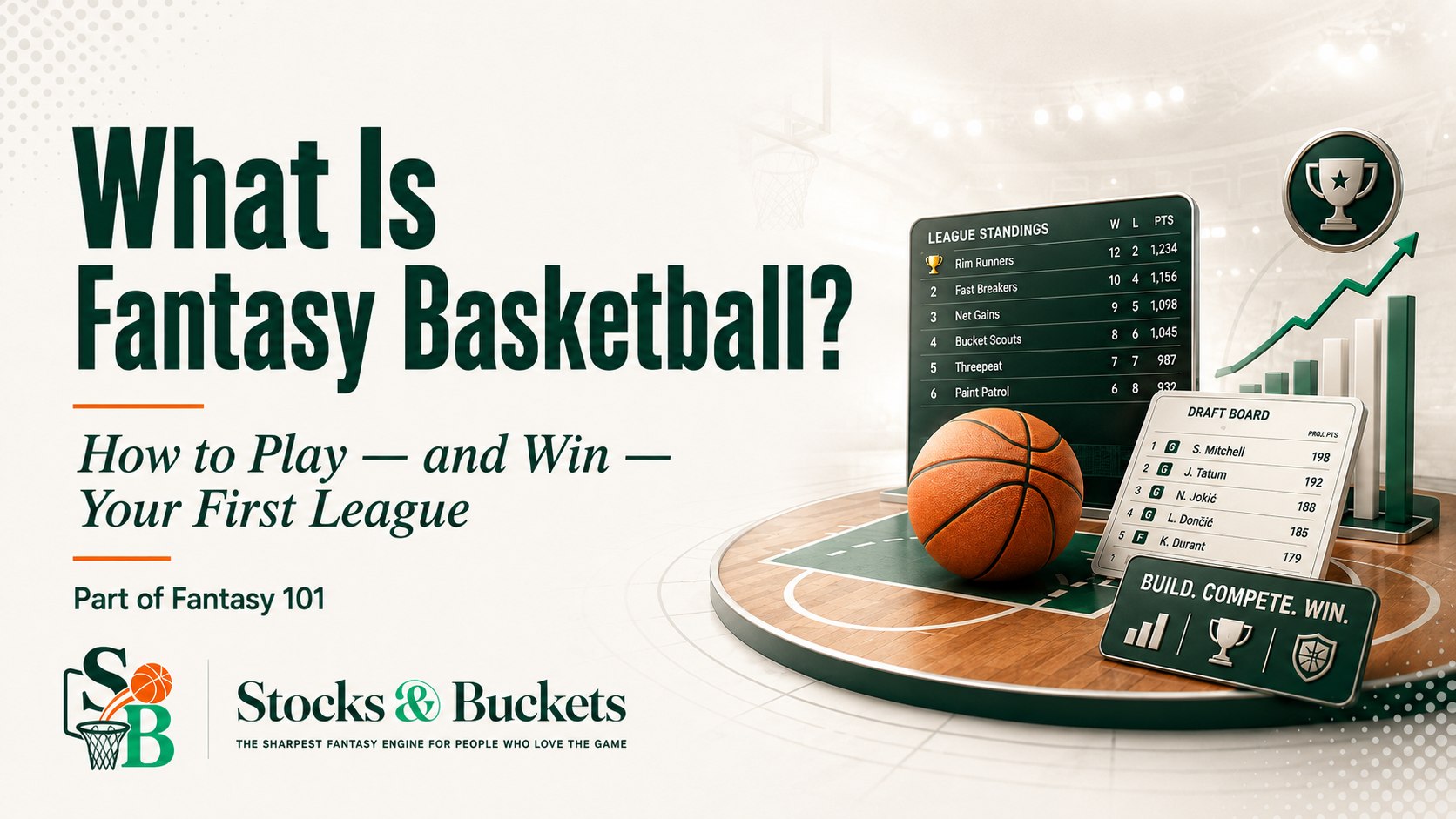
Somebody invited you to their fantasy basketball league, or you watched a friend celebrate a stranger's ninth rebound like it was a game-winner, and now you're here asking the honest question: what actually is this?
Welcome. This is Fantasy 101, our from-scratch series for people picking up fantasy basketball for the first time — no jargon walls, no "everybody knows this" shortcuts. By the end of this guide you'll understand the whole game: what a league is, how you score, what a draft is, and what you actually do all season. Over the next two weeks we're publishing the full series — every scoring format explained, a first-draft playbook, the week-to-week manager's routine, and the beginner mistakes to skip entirely.
What is fantasy basketball, exactly?
Fantasy basketball is a game you play against friends (or strangers) where each of you builds a roster of real NBA players, and your team scores based on what those players actually do in real games. Jokić grabs a rebound in Denver; your fantasy team gets credit for it. Your job is to assemble and manage the roster that out-produces everyone else's. That's it. Everything else — drafts, waivers, trades, categories — is just the machinery around that one idea.
The magic isn't the rules, though. It's what the game does to your relationship with basketball: suddenly a random Tuesday game between two teams going nowhere matters, because your center needs eight boards and a couple of steals. You watch closer, you care harder, and you have a group chat full of people to argue with about it. That's the product. The winning is just the argument you get to hold over them.
How a fantasy basketball league works
A league is a group of teams — usually 8 to 14, most commonly 10 or 12 — each run by one person (that's you, the manager). Leagues live on an app: ESPN, Yahoo, Sleeper, and Fantrax are the big four, and they all handle the bookkeeping — scores, standings, transactions — automatically.
Every NBA player belongs to at most one fantasy team in your league. That scarcity is the whole game. There's exactly one Nikola Jokić, and if your rival drafted him, you can't have him — unless you trade for him.
A league runs on a few shared settings, worth checking before you join:
| Setting | The usual default | Why it matters |
|---|---|---|
| League size | 10 or 12 teams | Bigger leagues = thinner talent pool = bench depth matters more |
| Scoring format | Head-to-head, 9 categories, or Points | Decides how you win — more on this below |
| Roster size | 13 players (10 starters, 3 bench) | How many decisions you make each week |
| Lineups | Set daily or weekly | Daily = more involved, weekly = more forgiving |
| Draft type | Snake or Auction | Snake: take turns, order reversing each round; auction: everyone bids from a budget |
Public leagues (the app matches you with strangers) are a fine sandbox. But fantasy is roughly ten times more fun in a private league with people you know — the trash talk is the point.
How fantasy basketball scoring works
There are two families of scoring, and knowing which one your league uses changes everything about how you should play:
Points leagues convert everything a player does into one number — say, 1 point per point scored, 1.2 per rebound, 1.5 per assist — and the team with more total points wins. Simple, fantasy-football-ish, great for a first season.
Category leagues — the format most long-running leagues use, and the one this site is built around — score you across separate statistical categories: points (PTS), rebounds (REB), assists (AST), steals (STL), blocks (BLK), three-pointers made (3PM), field-goal percentage (FG%), free-throw percentage (FT%), and turnovers (TO). Those short forms are the naming convention you'll see on every fantasy app — and on our board. That's the classic 9-cat setup, and the goal is simple: you're not piling up one big number, you're trying to win more categories than your opponent — take at least 5 of the 9 in a standard head-to-head week and the week is yours. Suddenly a player like Walker Kessler, who won't dazzle anyone with scoring, becomes a weapon — because blocks are a whole category and he devours them.
One quirk worth flagging on day one: in category leagues, turnovers count against you, and the two percentage categories care about efficiency, not volume. A high-usage star who shoots 78% from the line is actively hurting you in a category every week. This is why fantasy value and "real-life fame" are different lists — and why our projections board sometimes ranks players in ways that surprise casual fans.
We break down every format — including Roto, the classic season-long grind where you're ranked across all categories all year — in the next piece in this series.
The fantasy draft: where your season is mostly won
Before the season starts, your league holds a draft — the single most fun hour in fantasy. In the standard snake draft, managers take turns picking players until every roster is full; the order reverses every round, so whoever picks last in round one picks first in round two.
Draft night is where preparation shows. Most of your opponents will walk in with the app's default rankings and vibes. You'll walk in knowing that rankings are really projections — forecasts of what each player will produce this season — and that the sharpest managers draft off expected production, not last year's highlight reel or a famous name having a birthday. (It's the difference between drafting Jayson Tatum on reputation and knowing exactly how many games he's likely to play this season — and what that does to his value.)
Two things separate a good draft from a bad one:
- A board you trust. A ranked list of players, built for your league's exact format — not a generic magazine list. Ours is right here, with a written view on every single player explaining the why behind the rank.
- A plan for game volume. Availability is quietly one of the biggest edges in fantasy: a slightly less talented player who plays 75 games usually beats a star who plays 55. Beginners chase talent; winners weigh talent and games.
The third piece in this series is a full first-draft playbook — snake strategy, auction drafts, and how to prep in one evening.
How to play: what you actually do all season
Here's the part nobody explains to beginners: the draft is maybe 60% of your season. The rest is a weekly routine that takes 15 minutes a day if you're casual and cheerfully consumes your whole evening if you're us. The loop:
- Set your lineup. Players only score for you when they're in your starting slots. Injured guy in your lineup = zeroes. The single most common beginner loss is a forgotten lineup on a busy night. One league setting changes the rhythm here: daily leagues let you adjust the lineup every game night — more moves, more edge for active managers — while weekly leagues lock it for the whole week: one deadline, far more forgiving if you're busy. Check which one yours is before the season starts.
- Work the waiver wire. Every player nobody drafted sits in a free-agent pool, and breakout seasons surface there every single week — a rotation change here, an injury there, and suddenly a nobody is putting up starter numbers. Claiming those players before your rivals is called a waiver pickup, and it's the sharpest ongoing edge in the game.
- Stream the schedule. NBA teams play 2, 3, or 4 games in a given week. A mediocre player with 4 games often out-produces a good player with 2. Cycling your last roster spot to chase games — streaming — is a real, learnable skill.
- Make trades. The group-chat centerpiece. You have three centers and no assists; your rival has Trae Young and no rebounds. Deals get made, feelings get hurt, seasons get saved.
- Make the playoffs. In head-to-head leagues, the top teams enter a bracket in the final weeks of the NBA regular season (usually March). Win the bracket, win the league, own the group chat forever.
Piece four of this series walks through the whole in-season routine — waivers, streaming, trades, and the schedule tricks — in detail.
Fantasy basketball terms to know on day one
The full glossary lives here, but these eight terms cover 90% of your first season:
| Term | Meaning |
|---|---|
| Manager | You — the person running a fantasy team |
| Roster / lineup | Your full player list / the subset actually scoring for you today |
| Snake draft | Turn-based player selection; order reverses each round |
| Waivers / free agents | The pool of unrostered players you can claim |
| 9-cat | The classic nine-category scoring format |
| Punting | Deliberately conceding one category to dominate the others (yes, it's smart — it gets its own guide soon) |
| Streaming | Rapidly cycling a roster spot to maximize games played |
| IL spot | A roster slot for injured players so they don't clog your bench |
How to actually win your first season
We'll be specific, because "have fun and learn" is advice for people who like losing:
- Know your format before you draft. Points and categories reward different players. A format-blind draft is the classic rookie error.
- Draft for games played, not just talent. Availability wins leagues. It's the quiet conviction behind our entire ranking methodology.
- Be the most active manager in your league. More waiver pickups, more lineup attention, more schedule awareness. In beginner leagues, activity alone wins maybe a third of the time.
- Use a board with reasons. Anyone can hand you a ranked list. You'll make better calls — draft night and all season — when you know why a player ranks where he does. That's what we're for.
- Stay for the fun. Trash talk generously, celebrate ninth rebounds, take a meaningless Tuesday far too seriously. That part needs no strategy guide.
The rest of Fantasy 101: your reading order
This page is the front door. The rest of the series walks you from "I just joined a league" to "I'm playing for a title," in the order the season actually happens:
- Fantasy Basketball Scoring, Explained — Roto, head-to-head categories, points. What each format rewards, and which one you're actually in.
- The Fantasy Basketball Draft Guide — snake vs auction, ADP, tiers, and a round-by-round plan for your first draft.
- Lineups: Slots, Locks & Roster Spots — position slots, the IL, and the daily-vs-weekly lock rules that decide how often you can actually change anything.
- Waivers, Streaming & Trades — how to run your team between drafts: the wire, FAAB, streaming, and making a deal that gets accepted.
- How to Win Your Matchup & the Playoffs — the 5-of-9 math, which categories to concede on purpose, and how to be built for February.
The series closes with the beginner mistakes that quietly cost leagues — and the fixes. When you're ready to put any of it to work, our projections board and tools are free with an account.
Quick answers for first-timers
How many players are on a fantasy basketball team?
Most leagues roster 13 players — ten starters and three bench spots — plus one or two IL slots for hurt players. Across a 12-team league that's roughly 156 rostered players, which is why the deep names on our projections board matter more than casual fans expect.
Is fantasy basketball hard to learn?
No — the mechanics take about an evening. Read this guide, do one practice mock draft, and you're league-ready. Weekly-lineup leagues are the most forgiving if you're busy; daily leagues reward the managers who check in every night.
Does it cost anything to play fantasy basketball?
Standard leagues on the major platforms — ESPN, Yahoo, Sleeper, Fantrax — are free to create and join. Some private leagues collect a buy-in for a season prize pot, but that's the league's choice, not a platform requirement.
When do fantasy basketball drafts happen?
Late September through late October, right before the NBA season tips off. Draft as close to opening night as your league can manage — every preseason day brings injury and rotation news that changes player values (our board updates through the preseason for exactly that reason).
What's the best fantasy basketball format for beginners?
Head-to-head most-categories (9-cat) is the sweet spot for a first season — weekly matchup fun plus the full category game. A points league is the gentlest possible start, and most managers graduate to categories within a season or two. The full comparison is next in this series.
Was this the beginner's guide you needed?
This is the hub of Fantasy 101. Next up in the series: every scoring format explained — Roto, head-to-head, points, and which one to pick. New around here? Meet Stocks & Buckets.
New analysis, every week.
Our sharpest reads and the views we'd act on, plus early access to the tools.
Join us