

Fantasy Basketball Draft Guide: Snake, Auction & How to Prep
A beginner's fantasy basketball draft guide — how snake and auction drafts work, prep in one evening, read rankings and ADP, plus a round-by-round plan.

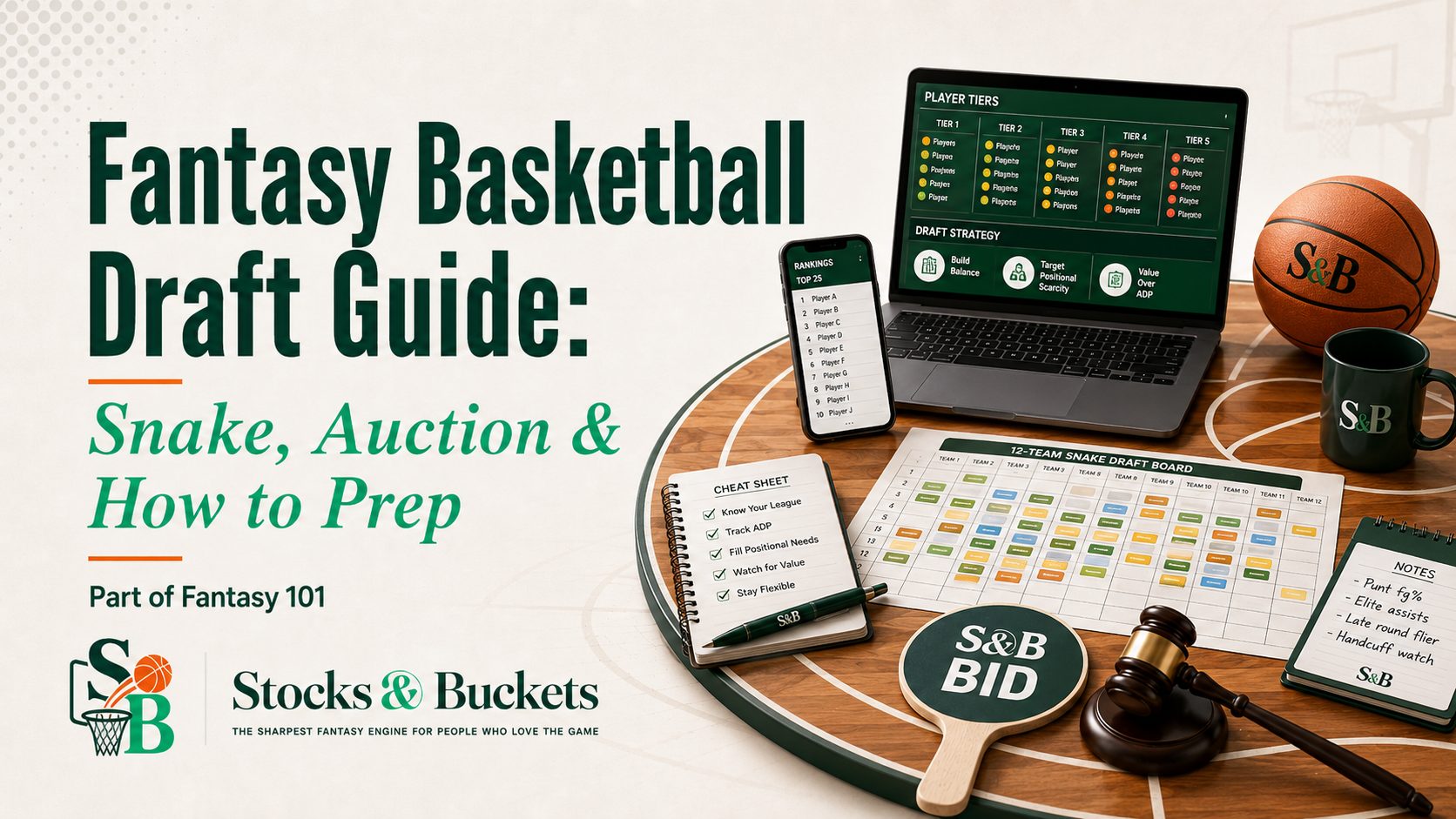
Part of Fantasy 101 — our from-scratch guide to fantasy basketball. Catch up first: What is fantasy basketball? and every scoring format, explained.
Draft night is the best hour of the fantasy calendar. It's also where beginners quietly lose their season before it starts — not by lacking basketball knowledge, but by walking in without a plan while someone else walks in with one. This guide is the whole plan for your fantasy basketball draft: how both draft types actually work, the one-evening prep routine, how to read a rankings board like a sharp, and what to do phase by phase while you're on the clock.
How a snake draft works
The snake draft is the standard. Managers pick in a set order, and the order reverses every round — so the manager picking last in round one picks first in round two. The snake exists for fairness: without it, whoever picked first would win the draft by default.
Here's what the first three rounds look like for a 12-team league:
| Draft slot | Round 1 pick | Round 2 pick | Round 3 pick |
|---|---|---|---|
| Team 1 | 1st | 24th | 25th |
| Team 4 | 4th | 21st | 28th |
| Team 8 | 8th | 17th | 32nd |
| Team 12 | 12th | 13th | 36th |
Notice the corners. Team 12 waits eleven picks, then makes two picks back-to-back — the turn. Drafting at the turn means long droughts but paired picks (great for grabbing two players who work together); drafting early means the best single player but long waits in between. Neither slot is "better" — they demand different plans, which is exactly the point of having one.
Everything else is logistics: each manager has a timer per pick (usually 60–90 seconds), every drafted player goes on that manager's roster, and the draft runs until rosters are full — typically 13 rounds. Miss your timer and the app auto-picks for you off its default list, which is how someone in every league ends up explaining a roster they don't remember choosing.
Snake draft — the trade-offs:
| The good | The catch |
|---|---|
| Simple and fast — take the best name on your board and go | You can't guarantee any one player; if he's gone, he's gone |
| Fair by design — the reversing order stops any slot from hoarding value | Your draft slot dictates your options; you react more than you dictate |
| Forgiving for beginners — hard to catastrophically blow up in one pick | Shallower strategic ceiling than an auction once you know what you're doing |
That trade — control for simplicity — is exactly why it's the beginner standard.
How an auction draft works
The spicier alternative. In an auction, there's no draft order at all: every manager gets a budget (traditionally $200, fake money), players are nominated one at a time, and everyone bids. Any player can be yours — if you'll pay.
The strategic texture is completely different. In a snake draft, you can only react to what falls to you. In an auction, you could roster Nikola Jokić and Victor Wembanyama — you'd just have about $110 left for eleven other players, and that lopsided build (two monsters plus a bargain bin, known as stars and scrubs) is a real, legitimate strategy. So is spreading $200 evenly across a lineup with no weak link. Auctions reward people who understand value per dollar, punish people who panic-bid early, and reliably produce the funniest moments in fantasy (someone always spends $4 total on their last six players).
Auction draft — the trade-offs:
| The good | The catch |
|---|---|
| Total control — any player can be yours if you're willing to pay | Longer and more intense; a 12-team auction runs closer to two and a half hours |
| No slot disadvantage — everyone chases the same players on even footing | Easy to overspend early and strand your final picks on scraps |
| Real strategic depth — value-per-dollar rewards genuine skill | Punishing for beginners who don't yet have a feel for what players cost |
Our advice for a first season: play a snake draft. Auctions are wonderful and you should try one in year two, once you can feel what players are worth without a reference sheet in your other hand.
How to read fantasy rankings and ADP like a sharp
Every draft tool shows you a ranked list. The difference between managers is understanding what a good list is: a projection of next season, not a memory of last season. Those are different things, and the gap between them is where drafts are won:
- Reputation lags reality. Big names decline, roles change, teams re-shuffle. A famous player coming off a down or injury-shortened year often costs a premium pick anyway, purely on name. Meanwhile the market is slow to trust a breakout.
- Games played are value. This is the one beginners skip entirely. A per-game stud who suits up 55 times usually returns less than a slightly lesser player who plays 75. When our board projects a player like Anthony Davis, the expected games number is doing as much work as the talent evaluation — read both.
- Format shapes rank. As we covered in the formats guide, a category league prices efficiency and specialists very differently from a points league. Make sure the list you're using is built for the game you're actually playing.
You'll also meet the term ADP — average draft position, the market price where each player is typically being drafted across thousands of real drafts. ADP isn't advice; it's the market. The play is to compare a board you trust against ADP: when your board says a player is 15 spots better than where the market drafts him, that's a discount you can plan for. Our projections board carries a written view on every player precisely so you can judge the why behind each rank yourself — the reasoning is the product, not just the number.
The one-evening draft-prep routine
You do not need a week of research to out-prep most of your league. You need one focused evening:
- Confirm your league's settings (15 min). Format, categories, roster size, lineup slots, draft slot. Every later decision keys off this.
- Pick your board (10 min). One trusted, format-matched ranking source. Print it or keep the tab open. (Ours lives on the projections board, updated as news breaks through the preseason.)
- Mark tiers, not just ranks (30 min). Group players into rough tiers of similar value. Mid-draft, the question is never "who's ranked 41 vs 44" — it's "the tier at my position is about to run dry, act now or wait." Tier-thinking is the single biggest practical upgrade a beginner can make.
- Flag ten targets and five fades (20 min). Players you like more than the market (targets to reach for a few spots early) and players you trust less than their price (fades you'll let someone else pay for). Our per-player views flag exactly these mispricings — the names sitting higher or lower on our board than on the apps.
- Do one mock draft (45 min, optional but recommended). Every platform offers practice drafts against bots or strangers. One run-through kills 90% of draft-night nerves and teaches you the timer's rhythm.
That's it. Two hours, and you'll be more prepared than two-thirds of any beginner league.
A phase-by-phase plan for draft night
Every draft has three acts. Here's what each is for:
The early rounds (1–4): buy floors. This is where seasons are lost, not won. You want elite, dependable, high-games producers — the players whose bad outcome is still good. Resist the urge to be clever early; clever is for later. If a star's projected games make you nervous, this is the wrong neighborhood for the gamble.
The middle rounds (5–9): buy your build. The draft's real skill zone. The famous names are gone and every pick is a trade-off between scoring, categories, and roles — this is where your roster takes its shape. Chase scarce categories (blocks, steals) before they dry up: category specialists like Rudy Gobert types vanish in a two-round window once the league notices. Keep glancing at your category totals so you don't accidentally build a team with four point guards and no rebounds.
The late rounds (10–13): buy lottery tickets. Floors don't matter anymore — a late pick who merely "pans out fine" is replaceable off waivers by November. Swing for upside: young players one rotation change from a breakout, new arrivals with a suddenly open role (Tyrese Haliburton's rookie-year leap remains the genre classic). If a late flier busts, you drop him in week two and lose nothing.
Three table-manners rules that double as strategy: don't draft two injured players in the first ten rounds, don't draft a second center before you have any guards (roster slots are real), and never spend your last two picks on "safe veterans" — safe and 12th-round shouldn't coexist.
Draft-day mistakes to leave for your rivals
- Drafting last year's points-per-game. The whole market does this; the edge is refusing to.
- Ignoring games played. The quiet league-winner, one more time, louder: availability is value.
- Position panic. Grabbing a mediocre center in round 5 "because centers are running out" when three equivalent ones sit two rounds later. Tiers, not vibes.
- Drafting your favorite team's players. We love loyalty. The standings don't.
- No plan at the turn. If you draft at slots 1 or 12, your picks come in pairs — plan pairs, not singles.
- Freezing on the clock. When in doubt: highest player on your board, next tier that's about to die. Done. The 60-second agonize-then-panic pick is a beginner signature.
Draft well and you'll spend the season managing a contender instead of rescuing a rebuild. Managing — the waivers, the streams, the trades that win leagues in March — is the next piece in this series.
Quick answers before draft night
How long does a fantasy basketball draft take?
A 12-team snake draft with 13 rounds and a 60–90 second pick timer runs about 90 minutes to two hours. Auctions run longer — closer to two and a half — because every player gets nominated and bid on individually. Block the evening; it's the best one of the fantasy year.
What order does a snake draft go in?
The pick order reverses every round — whoever picks 1st in round one picks last in round two, and the manager picking 12th gets back-to-back picks at the turn. No slot gets all the good picks; that's the point.
Is it better to have an early or late draft pick?
Neither, objectively. Early slots get the single best player but long waits between picks; late slots get paired picks at the turn — great for building category combinations. What matters is walking in with a plan for the slot you drew.
What should you draft first in fantasy basketball?
Best available player with a dependable role and a strong games-played outlook — not a position. Positional scarcity is a mid-round concern (blocks and steals specialists dry up fastest); round one is about floors. Our board shows both the per-game value and the games expectation for every name.
Should beginners do a mock draft?
Yes — exactly one is enough to matter. A practice run teaches you the timer's rhythm and kills most of the draft-night nerves. Every major platform offers free mock lobbies year-round.
Feeling ready for your first draft?
Next in Fantasy 101: running your lineup — roster spot types, daily vs weekly locks, and IL spots. Start from the hub: What is fantasy basketball?
New analysis, every week.
Our sharpest reads and the views we'd act on, plus early access to the tools.
Join us