

Fantasy Basketball Waivers, Streaming & Trades Guide
The in-season playbook — how the fantasy basketball waiver wire and FAAB work, streaming the NBA schedule, and trades: deadlines, vetoes, and how to win them.

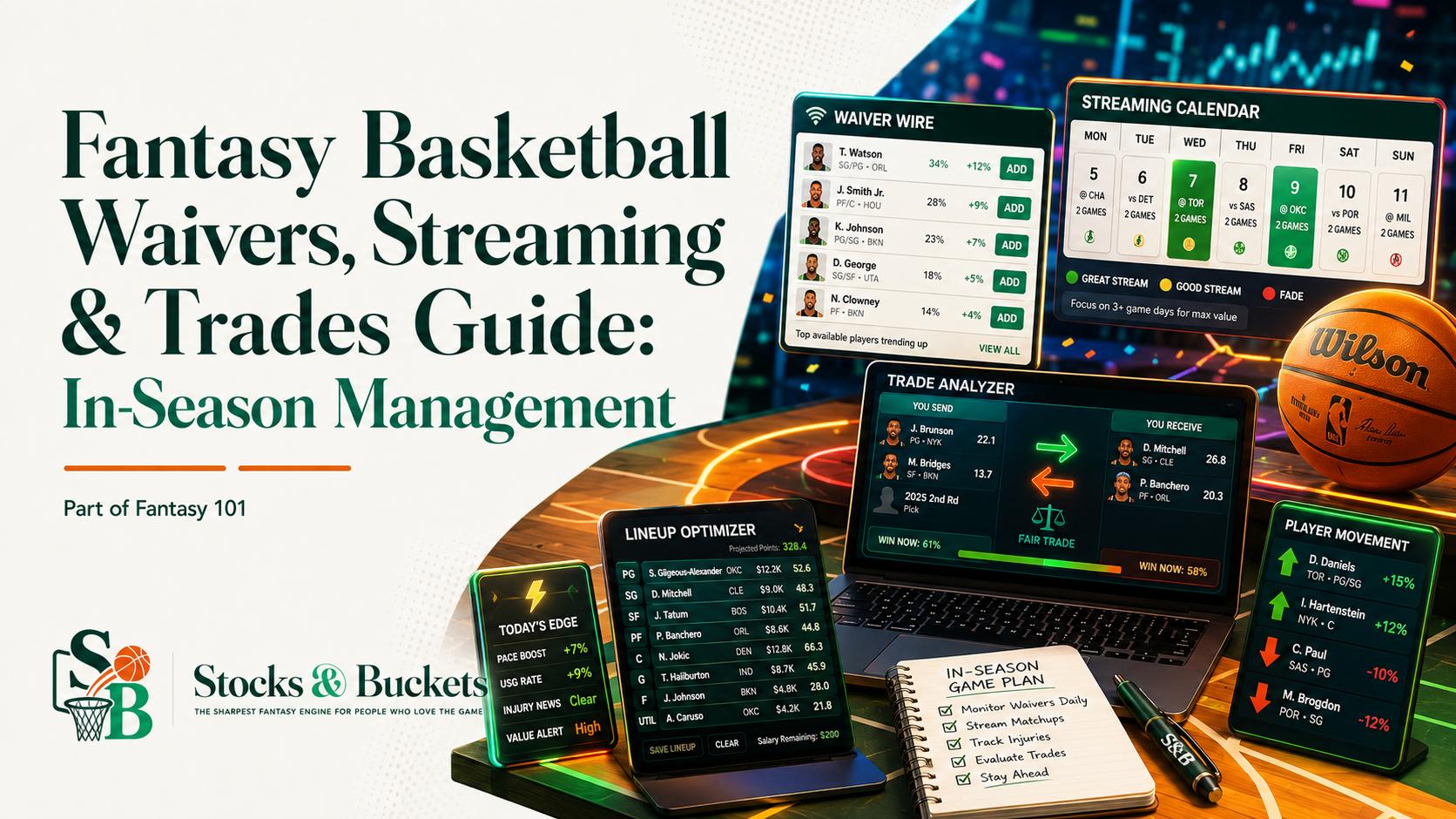
Part of Fantasy 101 — our from-scratch guide to fantasy basketball. Earlier in the series: what fantasy basketball is, how scoring works, your first draft, and running your lineup.
The draft handed you a roster, and the lineups article taught you to run it night to night. This is the third act: actually changing the roster — because here's a fantasy secret that survives every season: the draft gets the glory, but the season decides the trophy. In any beginner-to-intermediate league, the most active manager finishes top three almost by default, and activity means exactly three things: the waiver wire, streaming, and trades. This is the complete playbook for all three.
How the waiver wire works — and wins seasons
Every player nobody rosters sits in the free-agent pool, and every week real fantasy value surfaces there: a starter gets hurt and his backup inherits 30 minutes; a coach changes the rotation; a young player simply arrives. In-season value creation is constant — and it's first come, mostly-first served.
The "mostly" is the waiver system, which stops the fastest finger from taking everything. Here's the life cycle of a dropped player:
- He goes on waivers — a holding period, usually 1–3 days (a league setting), during which nobody can grab him instantly.
- Claims stack up. Anyone can place a claim while he's on waivers. Nothing happens immediately — that's the point.
- Claims process at the league's set time, typically overnight. The platform awards the player by priority (below), and every losing claimant keeps their money or priority.
- He clears. If nobody claims him (or once claims process), he becomes a pure free agent — first come, first served until someone drops him again and the cycle restarts.
Know your waiver clock
The mechanics above hide the detail that actually loses people pickups: timing. Learn three numbers from your league settings in week one — how long the waiver period lasts, what time claims process, and (in weekly-lineup leagues) when lineups lock. Then make claims part of the weekly ritual: place them the night before processing day, every week, before you need them. In a weekly league this is non-negotiable — a player who clears waivers Tuesday is worthless this week if your lineup locked Monday. The sharpest weekly-league managers place claims Sunday night so the new pickup is active for the full week ahead.
The three priority systems
| System | How it works | How to play it |
|---|---|---|
| Rolling priority | A queue; use a claim, drop to the back | Spend your #1 priority on real prizes, not marginal upgrades |
| Reverse standings | Worst team gets first claim, all season | Contenders must move fast on hot pickups — you'll rarely win a contested claim |
| FAAB budget | Season budget of blind-bid dollars (often $100); highest bid wins | Budget discipline: most weeks bid $1–3; save $20+ strikes for genuine league-changers |
FAAB deserves an extra beat, because it's the system where beginners bleed the most value. Rules of thumb:
- Most pickups are $1–3 players. The weekly streamer, the speculative stash, the injury fill-in — bid small. Your edge is volume of good small moves, not one triumphant bid.
- The $20+ strike is for role changes that will last months — the backup who just inherited a starting job behind a season-ending injury, the rookie whose minutes just doubled for good. Two or three of those windows appear per season. Being solvent when they do is the whole game; running dry in February is how contenders miss the pickup that mattered.
- $0 bids are real. Most platforms let you bid zero — the correct price for lottery tickets you'd shrug about losing. Know your league's tiebreak (usually waiver priority or reverse standings) since tied bids happen at the bottom.
Three habits that make you dangerous on the wire
- Read minutes, not points. A bench player who just scored 20 once is bait. A player whose role changed — suddenly starting, suddenly playing 32 minutes — is the real signal, because minutes are the raw material of every stat. It's the same lens our engine applies when news moves a player's projection: role first, box score second.
- Fill your categories, not your feelings. Losing blocks every week? The wire always has a shot-blocker nobody wants. In category formats, a targeted specialist pickup can flip a weekly category all by himself — our waiver tool ranks the pool against your roster's needs for exactly this reason.
- Drop without sentiment. Your 11th-round pick from October has no tenure. The question is never "did I draft him?" — it's "does he help this week and next?"
What is streaming? The schedule is a category
NBA teams play between 2 and 4 games in a fantasy week, and that spread is enormous. Meet the most underrated table in fantasy:
| Player A (better) | Player B (worse, more games) | |
|---|---|---|
| Per-game line | 18 pts, 7 reb, 4 ast | 13 pts, 5 reb, 3 ast |
| Games this week | 2 | 4 |
| Weekly total | 36 / 14 / 8 | 52 / 20 / 12 |
Player B is worse at basketball and better for your week — by a lot. Exploiting this on purpose is streaming: treating your last roster spot (or two) as a revolving door, picking up whoever has the most games (or the juiciest matchups) each week, then dropping them for the next batch. Over a season, a well-streamed spot manufactures hundreds of extra counting stats out of thin air. It's the closest thing fantasy has to legal counterfeiting.
How to actually run a stream
- Designate the spot. Your streaming slot is your lowest-commitment roster spot — the 13th man you'd drop without a second thought. If every player on your roster feels undroppable, you're carrying a zombie (check again).
- Count games in the weekly session. Sort the free-agent pool by games this week; our schedule planner does the counting across your whole roster and the pool. Four games beats three, and which nights matters too — a streamer who plays on the NBA's quiet nights fills lineup slots that would otherwise sit empty, effectively adding games your starters can't give you.
- Match the pickup to the matchup. Ahead by a mile in points but tight in threes and steals? Stream the wing specialist, not the best available big. In close weeks, the stream is a category tool — the matchup view shows where your week actually hangs.
- Mind two caps. Many leagues cap adds per week (often 4–7) — spend them early in the week so a full slate of games accrues, but never burn the last add before the weekend brings injury news. And in FAAB leagues, remember every stream costs budget; $1 streams are the engine, $5 streams are a leak.
- Don't stream away your percentages. Volume helps the counting stats, but a bad shooter can sink FG% in the same breath. In a tight week, check what the extra games cost, not just what they add.
How to trade: the group chat's favorite sport
Trades are where fantasy becomes a social deduction game, and where beginners get nervous. First the mechanics, then the craft.
The mechanics: offers, vetoes, and the deadline
A trade runs: offer → counter/accept → review period → processed. The review period (usually 1–2 days) is where beginners meet the veto — most leagues let managers vote down a pending trade, or give the commissioner sole review power. Know what vetoes are for: stopping collusion — two managers conspiring to stack one roster for the title run. That's it. A trade being lopsided in your eyes is not a veto case; lopsided-looking trades between two managers honestly trying to improve are just... fantasy basketball, and veto-happy leagues strangle their own trade market until nobody bothers offering. Our house rule: vote to allow unless you genuinely believe the two managers aren't both trying to win.
The other date that sneaks up on everyone: the trade deadline — a league-set cutoff, usually in February, a week or two before the fantasy playoffs. After it, no trades process, period. Two practical notes: check the date in week one (it hides in league settings next to the waiver rules), and start deadline-week conversations two weeks early — real negotiations take days, and the deadline is when contenders overpay. If you're selling, that's your market.
The craft: four principles
- Trade from surplus, for need. You're drowning in assists and bleeding rebounds; somewhere in your league is your mirror image. That's the trade — both sides genuinely improve, which is why "fair" trades that help both teams absolutely exist. Find your surplus by reading your category standings, not your feelings — the trade evaluator runs any deal through both rosters' category math.
- Buy low on process, not panic. The market overreacts to cold months and slow Octobers — especially for players returning from injury or settling into new teams (a Domantas Sabonis-grade rebounder having a quiet month is a target, not a warning). If the minutes and role are intact, slumps are discounts. Sell the opposite: a career role player shooting lights-out for three weeks is at his price ceiling.
- Value games remaining, not names. The trade you make in February is buying a player's rest-of-season: schedule, health, and role from here forward. Last year's All-Star nod is not a rest-of-season stat — check the current projection instead of the jersey.
- Don't nuke your categories. In category leagues, run the trade through your build: swapping Trae Young for a big man might win you rebounds and blocks — and quietly hand your assist category to the whole league. Every trade is a category trade.
And the human rule: make offers that respect the other manager's intelligence. Lowballs don't get countered; they get screenshotted.
The season, start to finish
A few calendar notes that catch every first-year manager: early season (Oct–Nov) is overreaction season — be aggressive on the wire (real breakouts surface in week one) but slow to panic on your own draft picks; three bad games is noise, a changed role is signal. Mid-season (Dec–Feb) is trade season and grind season — the managers still doing their weekly waiver-and-schedule ritual gain half a category a week on the ones who've drifted, and the trade deadline quietly splits the league into buyers and sellers. Playoff push (Mar) is where schedule work peaks: fantasy playoff weeks are set on the calendar, so check now which NBA teams play 4 games in those specific weeks and quietly collect their useful players before your rivals think to. Championships are won in the small print of the schedule.
None of it is complicated. All of it compounds. One honest weekly session for claims and streams, an open line in the group chat, and by March you'll be the manager everyone accuses of taking this too seriously — which is, of course, the trophy before the trophy.
Quick answers for week one
What is FAAB in fantasy basketball?
Free Agent Acquisition Budget — a season-long pot of blind-bid dollars (often $100) used to claim players off waivers; highest bid wins. Most weeks the right bid is $1–3. Save the $20+ strikes for genuine league-changers — running dry in February is how contenders miss the pickup that mattered.
When do waiver claims process?
Typically overnight — claims in before the deadline land the player on the winner's roster by morning. Waiver periods run 1–3 days after a drop, and both numbers are league settings: learn yours in week one. In weekly-lineup leagues, place claims the night before processing so the pickup is active before your lineup locks.
What does streaming mean in fantasy basketball?
Rapidly cycling your last roster spot to whoever has the most games (or juiciest matchups) that week. NBA teams play 2–4 games in a fantasy week, so a lesser player with 4 games often out-produces a better one with 2 — the table above shows the math.
When should you drop a player?
When his role has genuinely changed for the worse — not after a cold week. Minutes and role predict recovery; if both are intact, a slump is noise (and probably a buy-low for someone). Never hold out of draft-day loyalty: the only question is who helps this week and next.
How does a trade veto work?
After both sides accept, the league gets a short review window (1–2 days) to vote a trade down — or a commissioner reviews it solo. Vetoes exist to stop collusion, not trades you think are lopsided. Vote to allow unless you genuinely believe both managers aren't trying to win.
When is the fantasy basketball trade deadline?
A league-set date, usually February — a week or two before your fantasy playoffs — after which no trades process. Find it in your league settings in week one, and start deadline conversations two weeks early.
Which topic should we go deeper on first — waivers, streaming, or trades?
Next in Fantasy 101: winning your weekly matchup — the 5-of-9 math, mid-week pivots, and how the playoffs work. Start from the hub: What is fantasy basketball?
New analysis, every week.
Our sharpest reads and the views we'd act on, plus early access to the tools.
Join us