

How NBA Trades Work: Salary Matching & the Apron Rules (2026-27)
How NBA trades work — salary matching by team status, why the second apron bans aggregation, the Stepien rule on future first-round picks, and no-trade clauses.

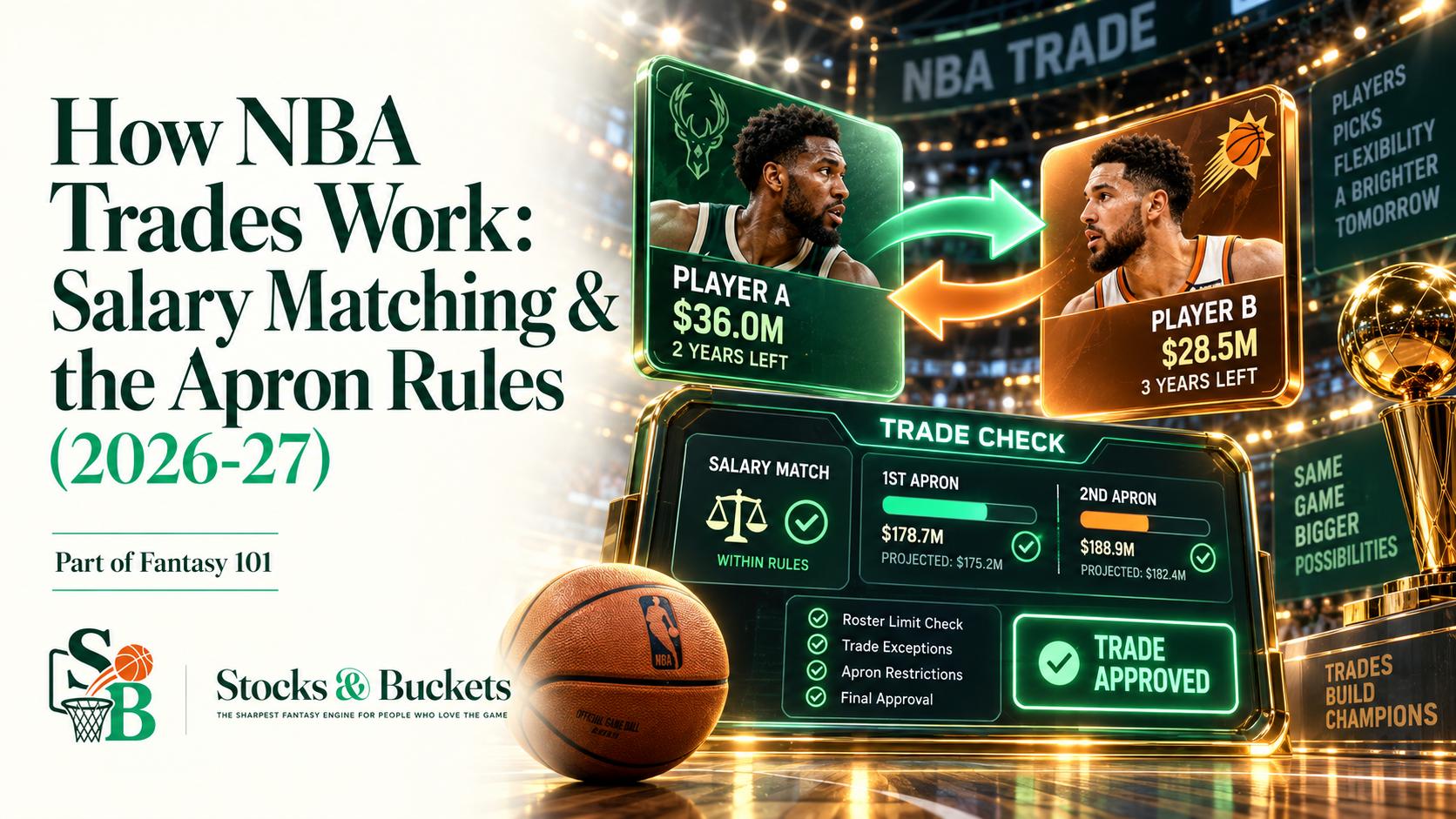
Part of The Cap Sheet — our series decoding how NBA front offices actually work. Start with the overview: How the NBA Salary Cap Works, then the money lines in the luxury tax & aprons deep dive.
Every trade season, the same head-scratcher shows up: a genuinely good player gets moved for what looks like a pile of spare parts — two role players, an expiring contract, a couple of second-round picks. Your first instinct is that's a robbery. Usually it isn't. It's arithmetic.
Two rules decide what an NBA trade can even look like before talent ever enters the conversation: the money has to match (an over-the-cap team can only take back so much salary), and the apron rules decide what's legal at all (whether you can even combine contracts, send cash, or move a pick). Learn those two, and the "why would they do that?!" deals stop looking crazy and start looking like the only legal shape the deal could take.
Rule one: the salaries have to match
Here's the engine under every trade. Most teams are over the salary cap ($164.961M for 2026-27), and an over-the-cap team can't just absorb whatever salary it wants — it can only take back an amount tied to the salary it sends out. Send out $20M, and there's a ceiling on what you're allowed to take back.
(A team with real cap room is the exception: it can simply absorb salary into that space without matching, up to the room it has. But most contenders — the teams making the headline trades — are over the cap, so matching is the world they live in.)
This single rule explains the "spare parts" mystery. To trade for a star on a big salary — the kind Kevin Durant or Anthony Davis carries — the team sending him out has to take back roughly that much salary in return, which often means several smaller contracts, not one comparable player. The bundle isn't the other team lowballing. It's the machine forcing the money to line up.
Rule two: how much you can take back depends on where you sit
Now the part almost nobody spells out. The matching percentage isn't one number — it tightens as a team climbs the tax-and-apron ladder. The higher your payroll, the less flexibility the league gives you. Here's the full ladder for 2026-27:
| Where the team sits | How much salary it can take back |
|---|---|
| Below the tax line (under $200.428M) — small deal (outgoing ≤ ~$7.5M) | ~200% of outgoing + $250K |
| Below the tax line — mid deal (~$7.5M–$29M outgoing) | outgoing + $7.5M |
| Below the tax line — large deal (> ~$29M outgoing) | 125% of outgoing + $250K |
| Taxpayer (over the tax line, under the first apron) | 125% + $250K, flat |
| First-apron team (over $209.015M) | 110% of outgoing |
| Second-apron team (over $221.686M) | 100% — dollar-for-dollar |
Read the pattern top to bottom: the cheaper you are, the more generous the league is. A below-tax team on a small deal can take back roughly double what it sends out. A second-apron team gets nothing extra — every dollar in has to be matched by a dollar out. (Those dollar thresholds aren't fixed forever; they tick up a little each year as the cap grows, so treat them as approximate current bands, not carved-in-stone lines.)
That top row is the sneaky-powerful one. A rebuilding team well under the tax can send out a $6M expiring contract and legally haul back nearly $12.25M in salary — a great way to buy a useful player by absorbing his contract while barely sending talent the other way.
A worked example: same trade, two very different teams
Let's make the ladder concrete. Two teams each want to add one $18M player. Watch how differently the rule treats them.
Team A is below the tax line. At $18M outgoing, they're in the "mid deal" band, so they can take back outgoing + $7.5M. To match an $18M player, they need to send out only enough that their number plus $7.5M clears $18M — roughly $10.5M of outgoing salary does it. They can bring in an $18M player while shipping out barely more than half his salary. Comfortable.
Team B is over the second apron. Same target, but they're locked at 100% — dollar-for-dollar. To bring in $18M, they must send out a full $18M in salary. And here's the killer: they can't aggregate. They can't bundle a $10M guy and a $9M guy to hit that $18M. They need one single outgoing contract worth ~$18M to match one single incoming contract. If they don't happen to have a matching salary lying around, the trade is simply illegal — no amount of creativity fixes it.
Same player, same league, same day. One team adds him with room to spare; the other often can't add him at all. That gap is the entire story of modern roster-building.
Aggregation, and why the second apron kills it
That word — aggregation — deserves its own beat, because it's the tool the second apron takes away, and it's the one that matters most.
Aggregation just means combining two or more outgoing contracts to match one bigger incoming salary. It's the bread-and-butter of star trades: three $12M role players go out, one $36M All-Star comes back. Almost every team can do this.
A second-apron team cannot. It has to match single salary to single salary. This is, on purpose, the most punishing restriction in the whole CBA — because it means the league's most expensive teams, the ones with three max stars, are precisely the teams that can't trade for a fourth. A big salary like Nikola Jokić's or Giannis Antetokounmpo's can't be assembled out of spare parts by a second-apron buyer — they'd need one matching contract, which they almost never have. Two more second-apron handcuffs stack on top: such a team also can't send cash in a trade (a common sweetener for smaller deals) and can't use most of the other salary-absorbing tricks. The richest team in the league is often the one that can do the least.
And it flows the other way too: using certain tools — the taxpayer mid-level exception, or aggregating salaries at all — hard-caps a team at the second apron for the rest of the season (some tools hard-cap at the first apron). We unpack every one of those triggers in the luxury tax & aprons deep dive; the short version is that reaching for a shortcut today can wall off your payroll for the whole year.
The other currency: draft picks and the Stepien rule
Salary is only half of what changes hands. The other half is future first-round picks — and there's a rule that governs how freely you can spend them.
The Stepien rule (named for a former owner who traded away so many first-rounders his team was gutted) says a team can't trade away its first-round picks in consecutive future years. You have to keep a first-rounder every other year — no dealing this year's and next year's both away. On top of that, picks are only tradeable up to seven years out. So a team's tradeable draft capital is really a checkerboard: this year available, next year protected, the year after available, and nothing beyond the seven-year horizon.
| Draft-pick rule | What it means in practice |
|---|---|
| Stepien rule | Can't trade firsts in back-to-back future years — must keep one every other year |
| Seven-year limit | You can only deal first-round picks up to seven years into the future |
| Combined effect | Teams talk in "odd-year / even-year" picks; a team can run out of tradeable firsts entirely |
This is why you'll hear a front office say it's "out of picks to trade" even though it obviously has drafts coming — the ones it could trade are either locked by the Stepien rule or already spent. Draft capital is a finite, oddly-shaped resource, and it's frequently the real reason a deal can't get done.
No-trade clauses: the player's veto
One more wrinkle, rare but decisive: the no-trade clause. It's a contract provision that lets a player veto any trade — his team literally cannot move him without his sign-off. Very, very few players in the league have one (it's hard to earn and teams hate giving it), so when a star who does have one becomes available, he effectively picks his own destination. A team can't shop him to the best offer; it can only trade him where he'll agree to go, which quietly tanks its leverage and shrinks the market to a team or two.
(There's fine print here — a player traded mid-contract can pick up a one-year Bird-rights quirk, and some deals carry bonus triggers — but the part that moves the needle is simple: the veto. Hold that, and you hold the pen.)
The trade deadline, and ducking the tax
All of this comes to a head on one date: the trade deadline in early February. Before it, teams wheel and deal; after it passes, rosters are essentially locked for the stretch run and playoffs. No more trades until the offseason.
That deadline is also the last off-ramp for a team trying to duck the luxury tax. Because the tax bill is calculated on the end-of-season roster (we cover that clock in the aprons deep dive), a team projected into the tax in December can shed a contract in February and finish the year under the line — erasing a penalty that often dwarfs the player's actual salary. That's why a contender sometimes trades a perfectly useful rotation player for a cheaper body and a second-rounder at the deadline. It's not a talent decision. It's a tax decision, and the clock runs out in February.
Cap-speak, translated
Keep this near the trade tracker. When a report drops these phrases, here's what's actually true:
| Phrase | What it really means |
|---|---|
| "The salaries match" | The incoming salary fits within what the team's status lets it take back |
| "They had to aggregate" | They combined multiple contracts to match one bigger incoming salary |
| "They can't aggregate" | A second-apron team — every incoming salary needs one single matching salary out |
| "They're out of picks to trade" | Stepien rule and/or the seven-year limit have locked up their remaining firsts |
| "He has a no-trade clause" | The player can veto any deal — he picks where (and whether) he goes |
| "It's a salary dump" | Talent going out for cheaper salary/picks, usually to duck the tax before February |
| "They took back less money" | An apron team capped at 110% or 100% — no room to pile on payroll |
Why deadline deals are a fantasy goldmine
Here's where it pays off for your roster. A trade isn't one minutes-and-role event — it's two at once. A traded starter vacates minutes and shots on the team he leaves and reshuffles the depth chart on the team he joins. Both rotations move the moment the deal lands, and the deadline crams a season's worth of that into 48 hours.
- A contender salary-dumps a useful vet to duck the tax → the cheaper player behind him inherits real minutes on a good team. A riser hiding inside a cap decision.
- A team trades for a ball-dominant star → the guards already there lose usage, sometimes overnight. Fade the displaced before the market catches up.
- A rebuilder absorbs an expiring contract for pick value → a young player who was buried suddenly has a runway on a team with nothing to lose.
That last mile — a salary-matching quirk today becoming a minutes-and-usage change tomorrow — is exactly what our engine is built to catch. When a deadline domino falls, we re-project everyone it touches on both sides: new role, new minutes, new category value, so you're rostering the post-trade reality, not last week's depth chart. See where every player lands on our live projections board, and if you're hunting a category edge in the deadline churn, our punt builds guide shows how to turn a trade-driven bargain into a matchup win.
So when the deadline hits and a good player moves for spare parts, read it like a GM: the money had to match, and someone behind him just got minutes. Spot it a step before your league does — that's the edge.
Quick answers about NBA trades
Why do NBA salaries have to match in a trade?
Because most teams are over the salary cap, and an over-the-cap team can only take back a limited amount of salary relative to what it sends out. The exact percentage depends on where the team sits — below the tax line (generous), taxpayer, or over an apron (strict). It's why a star often comes back as a bundle of mid-sized contracts: the money has to line up.
What is salary aggregation in an NBA trade?
Combining two or more outgoing contracts to match one bigger incoming salary. Most teams can do it; a team above the second apron cannot — it has to match any single incoming salary with a single outgoing one, which makes trading for a star nearly impossible.
What is the Stepien rule?
It stops a team from trading its first-round picks in consecutive future years — you must keep a first-rounder every other year. Paired with the rule that picks are only tradeable up to seven years out, it's why teams think about draft capital in odd/even years and can "run out" of tradeable firsts.
What is a no-trade clause?
A rare contract provision that lets a player veto any trade. Very few players have one, so a star who does effectively picks his own destination — and shrinks his team's leverage to almost nothing.
When is the NBA trade deadline?
Early February. After it, teams can't trade for the rest of the season, so rosters lock for the stretch run and playoffs. It's also the last chance for a team to shed salary and duck the luxury tax before the season-end bill is calculated.
Did the salary-matching rules finally make blockbuster trades make sense?
Next in The Cap Sheet: the fine print — trade exceptions, sign-and-trades and the stretch provision. Figures reflect the NBA's official 2026-27 cap; mechanics follow the 2023 Collective Bargaining Agreement. New here? Here's who we are and how we think about the game.
New analysis, every week.
Our sharpest reads and the views we'd act on, plus early access to the tools.
Join us