
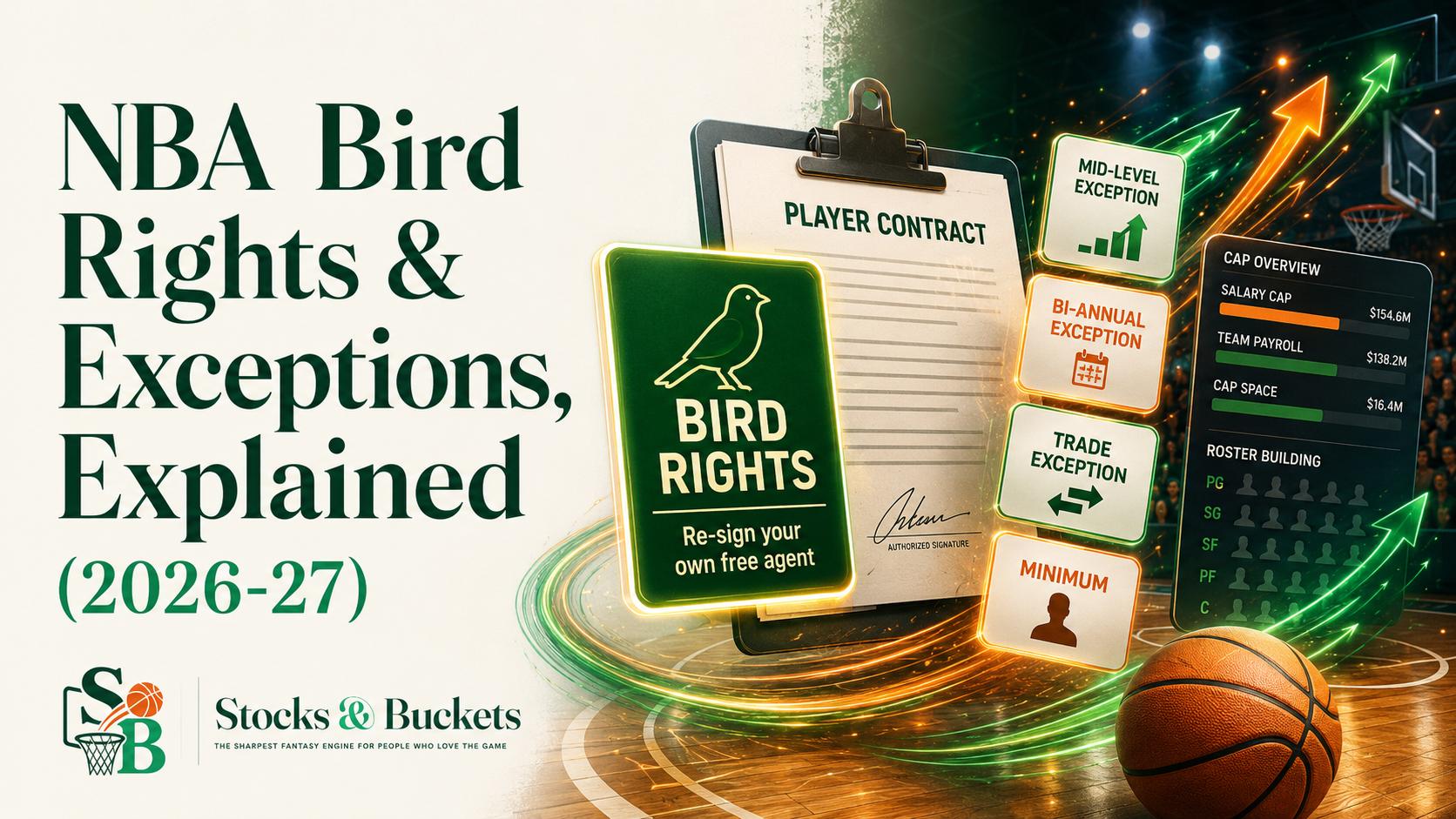
NBA Bird Rights & Exceptions, Explained (2026-27)
NBA Bird rights explained — Larry/Early/Non-Bird, the mid-level and bi-annual exceptions, the minimum, and how over-the-cap teams still keep their stars and add rotation help.

Part of The Cap Sheet — our series decoding how NBA front offices actually work. Start with the overview: How the NBA Salary Cap Works, then the money lines in the luxury tax & aprons deep dive.
Here's the question that breaks most fans' mental model of the cap: if a team is already over the salary limit, how on earth does it keep re-signing its own star to the max — and still add a useful free agent on top? The payroll math says there's no room. Yet it happens every summer.
The answer is a toolbox. The cap is "soft" for a reason — the league bolted on a set of legal doorways called exceptions so an over-the-cap team never has to strip itself for parts. This is the article that opens that toolbox drawer by drawer: Bird rights to keep your own guys, the mid-level and bi-annual exceptions to add outside help, and the minimum that everyone always has. By the end, "they used the taxpayer MLE and it hard-caps them" will read like plain English.
First, the recap: why exceptions exist at all
Quick refresher from the overview. The cap ($164.961M for 2026-27) isn't a wall — it's a line teams cross constantly. A hard cap would force a great team to break itself up the moment a young player got expensive, so the league deliberately left legal exits: ways to spend past the line for specific, approved purposes.
Every exception below exists to answer one of two needs: keep your own player (that's Bird rights) or add someone else's (that's the mid-level, bi-annual, and minimum). Keep that split in your head — it organizes the entire toolbox.
Bird rights: the re-sign-your-own toolbox
Bird rights are the single most important reason teams stay together. They let a club re-sign its own free agent while over the cap — but the power you get scales with how long the player has been yours. There are three tiers, named for how many seasons a player has accrued with the team without changing teams as a free agent:
| Tier | Earned after | Re-sign ceiling | Max length | Raises |
|---|---|---|---|---|
| Full (Larry) Bird | 3 seasons with the team | Up to the max, even far over the cap | 5 years | 8% |
| Early Bird | 2 seasons | Starting salary up to 175% of prior salary or 105% of the league-average salary, whichever is greater | 4 years | 8% |
| Non-Bird | 1 season | Up to 120% of prior salary | 4 years | 5% |
The crown jewel is Full Bird (the "Larry Bird exception," named for the loophole that first let Boston keep him). It's what lets a team pay a homegrown superstar — a franchise cornerstone like Nikola Jokić, Giannis Antetokounmpo, or Victor Wembanyama — the full max on a five-year deal without a dollar of cap room. It's the exception the whole soft-cap system was built around.
Notice the two structural perks that come only with re-signing your own guy: a team using Bird rights can offer 8% raises over up to 5 years, while everyone else — an outside team, or any team signing through an exception — is capped at 5% raises over up to 4 years. That extra year and steeper raise is a real thumb on the scale: your own team can always offer more total money and more security than anyone else. It's a feature, not an accident — the league wants homegrown stars to stay put.
The Early Bird math, worked
The middle tier trips people up, so let's make it concrete. Early Bird rights kick in after two seasons, and the starting salary is capped at the greater of two numbers: 175% of the player's prior salary, or 105% of the league-average salary.
Say a promising young wing just finished a rookie-scale deal paying $4M. His Early Bird ceiling isn't a flat percentage of the cap — it's whichever of these is bigger:
175% × $4M = $7.0M → vs. → 105% × the league-average salary
For a player coming off a small contract, that second number (tied to the league average, which runs well into eight figures) is almost always the bigger one — so the "105% of average" branch is what actually sets his starting salary, not the 175% of a modest prior deal. That's the whole point of the "whichever is greater" clause: it stops a cheap prior contract from artificially suppressing a good young player's raise. For a player already on a big salary, the 175% branch wins instead. Early Bird deals run up to 4 years — one short of Full Bird, which is exactly why teams covet that third season of tenure that unlocks the full version.
Non-Bird is the weakest tier: one season of tenure, a starting salary capped at just 120% of prior salary. It's enough to give a modest raise to a player you've only had a year — not enough to keep a breakout you can't otherwise pay.
The mid-level exceptions: three flavors of "add outside help"
Bird rights keep your own. To add someone else's free agent while over the cap, the workhorse tool is the mid-level exception (MLE) — a set chunk of money every over-the-cap team gets each year. But there isn't one MLE. There are three, and which one you get is decided by where your payroll sits. That's the part almost nobody explains:
| Exception | 2026-27 amount | Max length | Who gets it |
|---|---|---|---|
| Non-taxpayer MLE | $15.044M | 4 years | Over-the-cap teams below the first apron — the big one |
| Taxpayer MLE | $6.064M | 2 years | Teams in the tax, between the aprons |
| Room MLE | $9.366M | 3 years | Teams that dipped under the cap into "room" |
Read that as a ladder. A team that stays over the cap but keeps its payroll modest gets the full, non-taxpayer MLE — $15.044M, enough to sign a genuine starter. Push spending up into the luxury tax and you drop to the taxpayer MLE — $6.064M, less than half as much and only two years. And a team that cleared actual cap room to chase a star doesn't get either of those; it gets the room MLE ($9.366M), a smaller tool that's the trade-off for having spent its space directly.
You only get one of the three — never a menu. The league is essentially saying: the more you've already spent (or the deeper into the tax you've gone), the smaller the extra tool you're handed. It's a graduated brake on the richest teams stacking help.
Worked example: which MLE does a team get?
Picture three teams, same summer:
- Team A sits $5M over the cap, comfortably below the tax. → It gets the $15.044M non-taxpayer MLE and can sign a real rotation starter for up to 4 years.
- Team B is $10M into the luxury tax, between the aprons. → It drops to the $6.064M taxpayer MLE, 2 years max — a role player, not a starter.
- Team C renounced its holds and opened $20M in room to sign a free agent outright. → Its leftover tool is the $9.366M room MLE for a secondary add.
Same league, same rulebook — three different-sized tools, decided entirely by where each team chose to sit. When a beat reporter says "they only have the taxpayer MLE to work with," that single phrase tells you the team is a tax team and that its best outside signing tops out around $6M. That's a lot of information in five words.
The bi-annual exception: the every-other-year add
There's one more outside-help tool for over-the-cap teams below the first apron: the bi-annual exception (BAE), worth $5.477M in 2026-27 for up to 2 years. It's exactly what the name says — a team can use it only in every other season, never in back-to-back years. Burn it this summer and it's gone next summer.
Think of the BAE as a bonus mid-tier signing slot stacked on top of the non-taxpayer MLE — a team under the tax can, in the same offseason, use its full MLE on one player and the BAE on another. Two outside rotation pieces without a dollar of cap room. Like the big MLE, though, it comes with a string attached (more on that in a second): using it hard-caps the team at the first apron.
The minimum: the tool every team always has
No exception ladder, no tenure requirement, no apron test — every team can always sign a player to a minimum contract. The minimum scales with experience, from $1,357,763 for a rookie or zero-year player up to $3,876,529 for a 10-plus-year veteran.
Two things make the minimum quietly important. First, the league reimburses part of the cost of veteran minimums, so a team pays roughly the same whether it signs a rookie-minimum guy or a grizzled vet — which is why buyout-season veterans keep landing on contenders. Second, it's the only signing tool a team stuck above the second apron has left. When a title team's toolbox is otherwise empty, the minimum is how it fills its last bench spots.
Which exceptions come with a hard cap?
Here's the string we keep flagging. Some of these tools, when you use them, snap a hard cap onto your team at the first apron for the rest of the season — a wall you cannot cross for any reason, not to sign a buyout guy, not to replace an injured starter (we unpack hard caps fully in the tax & aprons deep dive). So a team has to ask not just "can I afford this signing?" but "am I willing to build myself a ceiling for the year?"
| Tool | Attaches a first-apron hard cap? |
|---|---|
| Non-taxpayer MLE ($15.044M) | Yes |
| Bi-annual exception ($5.477M) | Yes |
| Taxpayer MLE ($6.064M) | No (it's the tax-team tool by design) |
| Room MLE ($9.366M) | No |
| Bird / Early Bird / Non-Bird re-signs | No |
| Minimum contracts | No |
The logic: the two biggest outside-signing tools available to non-tax teams (the full MLE and the BAE) come with the apron leash, because the league doesn't want a team using its most powerful add-a-player tools and then spending freely past the apron. Re-signing your own — Bird rights — never triggers it. Keeping your guys is always allowed; loading up on outside help is what gets fenced.
Cap-speak, translated
Keep this next to the free-agency tracker:
| Phrase | What it really means |
|---|---|
| "They have his full Bird rights" | They can re-sign him up to the max, 5 years, over the cap, no room needed |
| "He only has Early Bird rights" | His raise is capped (175% of prior or 105% of average), and the deal maxes at 4 years |
| "They used the full MLE" | They signed an outsider for up to $15.044M — and just hard-capped themselves at the first apron |
| "They only have the taxpayer MLE" | They're a tax team; their best outside add tops out near $6M for 2 years |
| "They used the bi-annual" | A ~$5.5M outside signing — and they can't use it again next season |
| "They're down to minimums" | The expensive tools are gone; they can only add minimum-salary bodies |
Why the exceptions decide fantasy minutes
Every tool above is really a minutes-and-role event in disguise — because who signs where is who plays. And the exceptions tell you, before draft season, which teams are still shopping:
- A team that still holds its full $15.044M MLE can add a genuine rotation starter — a fantasy-relevant body who'll eat minutes someone on that roster is currently penciled in for. Track which teams have spent theirs and which haven't; an unused MLE is a role change waiting to happen.
- A team down to the taxpayer MLE or just minimums can't meaningfully add outside help. So when a starter goes down, the next man up inherits real minutes instead of a rented veteran — a riser hiding inside a capped-out contender.
- A Bird re-sign locks a star's usage in place for years, which quietly fixes the ceiling on everyone around him — the fourth guard on a team that just re-upped its franchise point guard isn't getting a bigger role any time soon.
That last mile — an exception used today becoming a minutes-and-usage change tomorrow — is exactly what our engine is built to catch. When a signing lands, we re-project everyone it touches: new role, new minutes, new category value, so you're drafting the post-signing depth chart, not June's. See where every player lands on our live projections board, and if you're hunting a category edge in the churn, our punt builds guide shows how to turn a cap-driven role change into a matchup win.
So next time a report says "they used the MLE" or "they kept his Bird rights," read it like a GM: someone's role just changed, and the fantasy edge is spotting the consequence a step before your league does.
Quick answers about Bird rights and the exceptions
What are NBA Bird rights?
Bird rights let a team re-sign its own free agent while over the cap. Full (Larry) Bird rights — earned after three seasons with the team without changing teams as a free agent — allow a max, five-year deal with 8% raises, far over the cap. Early Bird (two seasons) and Non-Bird (one season) are weaker versions with smaller starting-salary ceilings.
What is the mid-level exception?
A set chunk of money over-the-cap teams get to sign outside free agents. There are three in 2026-27: the non-taxpayer MLE ($15.044M, up to 4 years), the taxpayer MLE ($6.064M, up to 2 years), and the room MLE ($9.366M, up to 3 years). Which one you get depends on where you sit relative to the aprons and the cap.
Why can over-the-cap teams still re-sign their own players for the max?
Because of Bird rights. The cap is soft, and Full Bird rights let a team exceed it by any amount to keep its own free agent — which is why a homegrown star can be paid the max without the team clearing a dollar of room.
What is the bi-annual exception?
A smaller outside-signing tool worth $5.477M in 2026-27 (up to 2 years). A team can't use it in back-to-back seasons, and using it hard-caps the team at the first apron.
Do the exceptions come with a hard cap?
Some do. The non-taxpayer MLE and the bi-annual exception hard-cap a team at the first apron for the rest of the season. Bird rights, the taxpayer MLE, the room MLE, and minimum deals do not attach a first-apron hard cap by themselves.
Did the exceptions finally make 'how can they afford him?' make sense?
Next in The Cap Sheet: NBA contracts, decoded — max deals, the supermax, options and extensions. Figures reflect the NBA's official 2026-27 cap; mechanics follow the 2023 Collective Bargaining Agreement. New here? Here's who we are and how we think about the game.
New analysis, every week.
Our sharpest reads and the views we'd act on, plus early access to the tools.
Join us