

The NBA Luxury Tax & Two Aprons, Explained (2026-27 Numbers)
How the NBA luxury tax is calculated — the 121.5% formula, the bracket rates, the repeater penalty — plus the exact 2026-27 apron lines and the roster tools each one takes away.

Part of The Cap Sheet — our series decoding how NBA front offices actually work. Start with the overview: How the NBA Salary Cap Works.
You asked for the deep version. Here it is — the actual formulas, the actual rates, the actual 2026-27 dollar figures, and the part almost nobody explains: which salary number each rule is even measuring. By the end you'll be able to hear "they're hard-capped at the second apron" or "they're projected into the tax but they can duck it" and know exactly what's true, what it costs, and what tool just vanished.
In the overview we said the cap is "soft" — a line teams cross all the time. So what actually holds spending in check? A stack of higher lines, each one calculated off the cap, each one more punishing than the last.
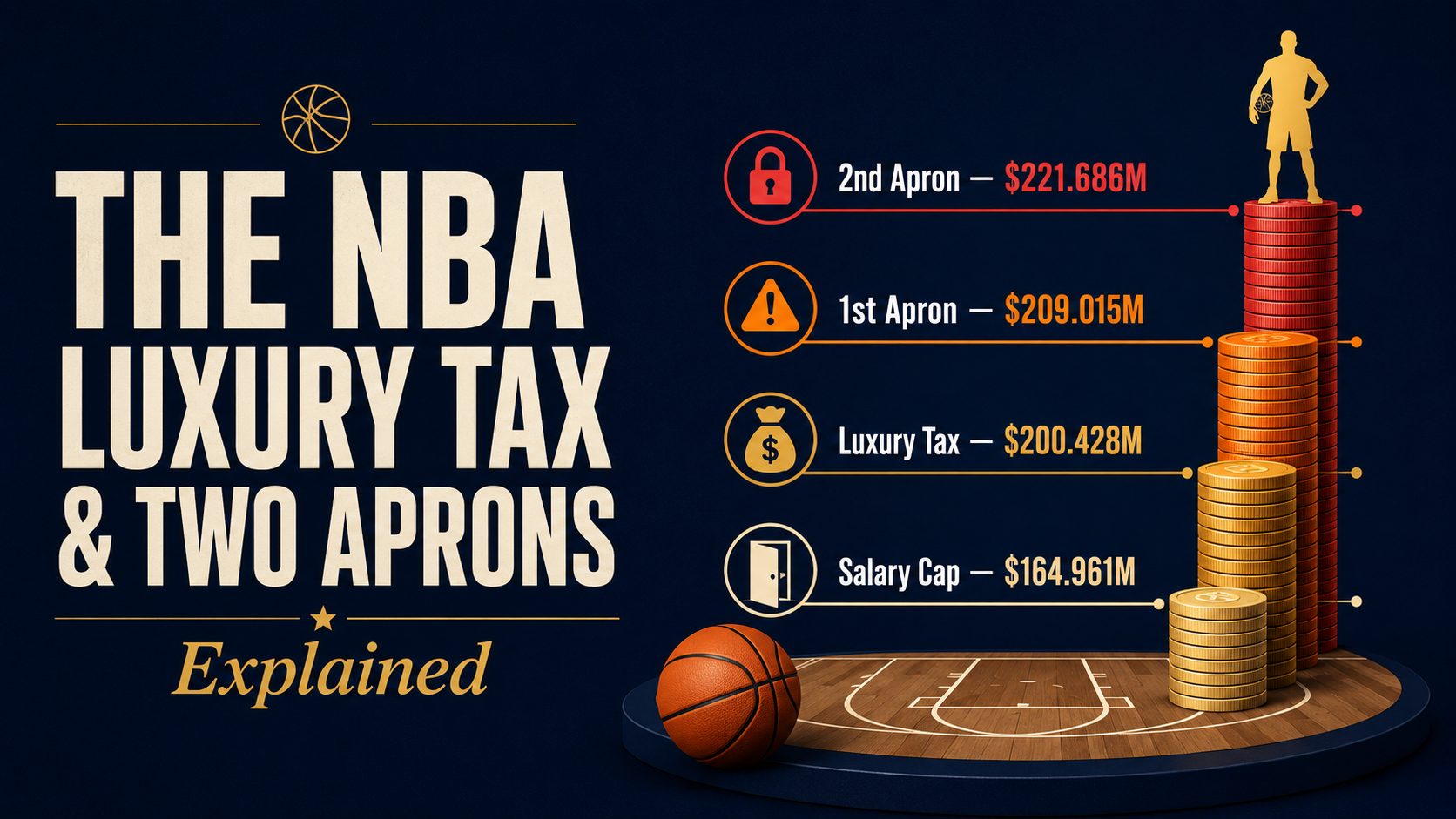
Here are the numbers the NBA set for the 2026-27 season on July 1 — exact figures, because the whole point is precision:
| Line | 2026-27 amount | What it is |
|---|---|---|
| Salary cap | $164.961M | The baseline the league calculates most other thresholds from. |
| Minimum team salary ("the floor") | $148.465M | Teams must spend at least this — the league forces low spenders up, too. |
| Luxury tax line | $200.428M | 121.5% of the cap. Cross it and you owe a penalty tax. |
| First apron | $209.015M | $8.587M above the tax line. Cross it and roster tools start disappearing. |
| Second apron | $221.686M | $21.258M above the tax line. Cross it and team-building nearly locks up. |
| Non-taxpayer mid-level exception | $15.044M | The full MLE. Using it hard-caps you at the first apron. |
| Taxpayer mid-level exception | $6.064M | The smaller MLE for tax teams — and, not by accident, the exact width of a 2026-27 tax bracket. |
| Room mid-level exception | $9.366M | The version for teams that actually dip under the cap into "room." |
Let's climb the stack — and learn to read it like a GM.
First, a trap: the NBA isn't always measuring the same salary
This is the single most misunderstood thing about the cap, so we're putting it first. When you see a team's payroll on ESPN or Spotrac, that is one number. The league uses different salary calculations for different rules:
- For the salary cap, the league looks at team salary — actual salaries plus cap holds and other cap charges.
- For the luxury tax, it looks at tax salary, locked in at the end of the regular season.
- For the apron rules, it uses apron team salary — which starts from team salary but then adjusts: it strips out some cap holds and adds back things like unlikely bonuses, certain 0-to-1-year minimum-salary adjustments, qualifying offers, required tenders, and second-round-pick exception amounts.
The practical upshot: a team can look "over the cap" on a website and still sit below an apron for transaction purposes — or vice versa. So when you hear "they're right up against the second apron," that's a specific, adjusted number the league computes, not the payroll figure you Googled. Keep that in your back pocket; it explains a lot of apparently contradictory reporting.
The ground floor: the soft cap (and the floor beneath it)
Quick recap, because everything is measured from here. The salary cap ($164.961M for 2026-27) is tied to league revenue — players and owners split "basketball-related income" roughly down the middle, and the cap is essentially the players' half divided across 30 teams. It's soft: the league left legal doors open ("exceptions") so teams can spend past it. Being over the cap is normal and, by itself, free.
There's also a floor: the minimum team salary ($148.465M). Spend under it and the league makes you pay the shortfall out to your players anyway. So the cap system squeezes from both ends — it nudges cheapskates up and taxes big spenders hard. Most of the drama lives at the top, so up we go.
The luxury tax, calculated step by step
Here's where fans wave their hands. Let's be mechanical.
Step 1 — find the tax line. It's not arbitrary: the tax line is always 121.5% of the salary cap.
$164.961M × 121.5% = $200.428M
Step 2 — find the overage. Take a team whose tax salary is $224.428M. That's $24.000M over the line. (Note "tax salary," per the trap above — not the ESPN number.)
Step 3 — slice the overage into brackets. This is the part people miss: the tax is not a flat rate. The overage is cut into brackets $6.064M wide in 2026-27 (the same figure as the taxpayer MLE — brackets scale with the cap; they were $5M when this system launched in 2023-24). Each higher slice is taxed harder:
| Slice of the $24M overage | Amount | Standard rate | Tax on that slice |
|---|---|---|---|
| Bracket 1 | $6.064M | $1.00 / $1 | $6.064M |
| Bracket 2 | $6.064M | $1.25 / $1 | $7.580M |
| Bracket 3 | $6.064M | $3.50 / $1 | $21.224M |
| Bracket 4 | $5.808M | $4.75 / $1 | $27.588M |
| Total | $24.000M | $62.456M |
Read the total twice. A $24M payroll overage doesn't cost $24M. It costs $24M in salary plus about $62.5M in tax — roughly $86.5M of total cash before any revenue-sharing effects. And look at the escalation: the last $6M slice cost nearly $28M, while the first cost barely $6M. It's cheap to dip a toe in and brutal to wade deep. (Standard rates are $1.00, $1.25, $3.50, $4.75 for the first four brackets, then +$0.50 per bracket after that.)
The repeater tax: the actual killer
Here's the one that breaks up contenders. If a team was a taxpayer in three of the four immediately preceding seasons, it's a repeater, and every rate roughly doubles: $3.00, $3.25, $5.50, $6.75 (then +$0.50 per bracket). Same $24M overage, repeater rates:
| Slice of the $24M overage | Amount | Repeater rate | Tax on that slice |
|---|---|---|---|
| Bracket 1 | $6.064M | $3.00 / $1 | $18.192M |
| Bracket 2 | $6.064M | $3.25 / $1 | $19.708M |
| Bracket 3 | $6.064M | $5.50 / $1 | $33.352M |
| Bracket 4 | $5.808M | $6.75 / $1 | $39.204M |
| Total | $24.000M | $110.456M |
So a repeater $24M over the line isn't making a $24M decision. It's making something closer to a $134M cash decision: $24M of salary plus about $110M of tax. That's why a winning team salary-dumps a genuinely useful rotation player — the multiplier on top of the salary, not the salary itself.
When is the tax actually calculated? (Not opening night)
A technical point that explains half of the trade deadline: the tax bill isn't locked in until the end of the regular season. Luxury tax is calculated on a team's roster as of the last day of the regular season, and the bill comes due later (around the end of June). That's why a team can be a "projected taxpayer" in November and still make a February salary dump to duck the tax — shedding a contract late to finish the season under the line, erasing the bill and protecting its repeater status for future years. When a contender trades a useful player for spare parts at the deadline, this clock is usually why.
The two aprons: permission lines, not price lines
Now the part reshaping the league. Above the tax sit two more lines — and the crucial difference is this:
The tax line charges you money. The aprons take away your tools.
A rich owner can choose to pay $60M or $100M in tax. But no owner can buy back the ability to aggregate salaries, use the full mid-level exception, send cash in a trade, or move a frozen draft pick. That's why the second apron is more dangerous than any tax bill.
How the aprons are set: like the tax line, they're fixed dollar figures the league recalculates each season so they grow with the cap. For 2026-27, the first apron is $209.015M ($8.587M above the tax line) and the second apron is $221.686M ($21.258M above it, $12.671M above the first apron).
What crossing the first apron costs you
A team above the first apron generally cannot:
| Lost tool | Plain-English impact |
|---|---|
| Acquire a player via sign-and-trade | You can't use another team's free agent as a trade target if it leaves you over the line. |
| Use the non-taxpayer MLE | You lose the bigger ($15.044M) free-agent tool, dropping to the taxpayer MLE. |
| Use the bi-annual exception | One fewer mid-tier signing path. |
| Sign certain buyout players | If the waived player's prior salary topped the non-taxpayer MLE, you're blocked. |
| Use certain prior-year trade exceptions | You lose some "stored salary slot" flexibility from earlier deals. |
| Take back extra salary in trades | You can't just pile on payroll through generous salary-matching. |
What crossing the second apron costs you
A team above the second apron generally cannot:
| Lost tool | Plain-English impact |
|---|---|
| Use the taxpayer MLE | No mid-level free-agent signing at all. |
| Aggregate salaries in trades | You can't combine, say, three $12M players to match one $36M star. |
| Send cash in trades | You lose a common sweetener that greases smaller deals. |
| Use certain trade exceptions | Less ability to absorb salary without sending matching money out. |
| Freely move your future first-round pick | Your pick seven years out gets frozen (untradeable). |
| Escape the pick penalty | Stay over the second apron too often and that frozen pick can slide to the end of the first round. |
Notice the ladder: money can push you over the tax forever if your owner is willing, but no amount of money buys back a second-apron restriction. The only exit is to get cheaper.
"Hard-capped": the line you legally cannot cross — and it's not always the first apron
You'll hear this constantly, and most fans get it half-right. When a team uses a tool that has an apron limit attached, the league snaps a hard cap onto that team at that apron for the rest of the cap year (through June 30) — a wall it cannot cross for any reason: not to sign a buyout guy, not to replace an injured starter, not for a dollar.
The update most people miss: you can be hard-capped at the first apron or the second, depending on the move:
- Hard-capped at the first apron by, e.g., using the non-taxpayer MLE, using the bi-annual exception, or acquiring a player via sign-and-trade.
- Hard-capped at the second apron by, e.g., using the taxpayer MLE or aggregating salaries in a trade.
The common idea: use a tool with an apron threshold, and that apron becomes a hard ceiling for the season. So "hard-capped" isn't a payroll size — it's a restriction a team opted into by using a shortcut.
Three different clocks are running
Half of understanding "cap-speak" is knowing when each rule bites. There isn't one deadline — there are several:
| Rule | When it matters |
|---|---|
| Luxury tax | Measured on your end-of-regular-season roster; bill arrives after the season. Duckable before then. |
| Apron transaction limits | The moment you try to sign or trade — checked against apron team salary right then. |
| Hard cap | Once triggered, it's a wall for the rest of the cap year. |
| Second-apron pick freeze | Based on being over the second apron at the end of the regular season. |
That table decodes sentences you'll hear all offseason:
- "They can do this deal now, but it hard-caps them." — the trade is legal, but it just built them a ceiling for the year.
- "They're projected over the tax, but they can still duck it." — the tax clock doesn't stop until April.
- "They're under the second apron today, but this trade pushes them over." — apron status is checked at the transaction, not season-end.
- "They need to get under by season-end to avoid the pick penalty." — the freeze keys off the final-day roster.
Cap-speak, translated
Keep this near your remote. When an analyst says it, here's what's actually true:
| Phrase | What it really means |
|---|---|
| "They're over the cap" | No normal cap room — but they can still sign players using exceptions. |
| "They're in the tax" | Tax salary is above $200.428M, so they're projected to owe penalties. |
| "They're $20M into the tax" | Tax salary is $20M over the line — but the bill is far more than $20M because of the brackets. |
| "They're hard-capped" | They used a tool that created a legal ceiling at the first or second apron. |
| "They need to duck the tax" | They want to finish the regular season under the tax line — to avoid the bill and/or reset repeater status. |
| "They're a second-apron team" | Above the most restrictive line, with major trade and free-agency tools gone. |
| "They can't aggregate salaries" | They can't combine multiple outgoing contracts to match one bigger incoming one. |
| "Their pick is frozen" | Their first-rounder seven years out can't be traded — they finished over the second apron. |
Why this reshapes rosters
Stack it up and you get the modern NBA's central tension: a roster with three max stars almost always lands in the second apron, and the second apron makes it nearly impossible to add role players, absorb salary, or keep your own picks. So the league's very best teams are often the ones least able to improve and the most pressured to break up.
That's the honest version of the "why would they trade him?!" blockbuster. When a good player like Kevin Durant, James Harden, or Anthony Davis gets moved for what looks like an underwhelming return, the cap sheet is usually one of the first places to look. It's rarely the only reason — age, injury risk, extension timing, locker-room fit, trade leverage and an owner's appetite all matter too — but it often explains why the deal happened now, why the return was shaped a certain way, or why a team valued salary relief over pure talent. A homegrown star on a supermax like Giannis Antetokounmpo, or a big tax number like a Rudy Gobert-sized deal, is exactly the kind of contract that turns a title team into a second-apron team overnight.
How we got here: the cap's evolution
None of this arrived at once. The rulebook grew a new layer every time teams found a way around the last one:
- Before 1984 — no cap at all. Rich teams outspent everyone, small-market franchises were folding, and the league feared for its survival. So players and owners agreed to a cap starting in 1984-85 (about $3.6M then; it's $164.961M now).
- 1984 — the soft cap is born, with the Larry Bird exception (re-sign your own free agent over the cap). Soft cap and loopholes were twins from day one.
- 1999 — max contracts + the luxury tax. After a lockout, the league capped what a single player could earn (there was no individual max before) and introduced the tax.
- 2011 — the tax grows teeth. The tax went progressive (the bracket system above), the repeater penalty arrived, and a first, single "apron" appeared.
- 2016 — the cap spike. A giant new TV deal jumped the cap in one summer, and Kevin Durant joined a 73-win Warriors team. The league watched a superteam form because of a cap quirk and never forgot it.
- 2023 — the two aprons + harsher rates. The current CBA built the second apron, reset the tax brackets (that sharp jump at bracket three), and cranked the repeater penalty. It's the most restrictive team-building environment the league has ever had.
The pattern is unmistakable: every rule answers a loophole in the last one. The two aprons are the newest, sharpest tool in a 40-year project to stop anyone from buying a dynasty.
Why any of this matters for your fantasy team
Because the aprons don't just move stars — they thin out benches, and bench minutes are where fantasy value is quietly born:
- A second-apron team can't add mid-season help (no MLE, no cash, no easy salary-matching). So when someone gets hurt, the next man up inherits real minutes instead of a rented veteran — a riser hiding inside a contender's roster crunch.
- A tax team waiving a veteran to duck a bracket (remember, that top slice runs $4.75 per dollar) hands the runway to a cheaper young player. That's a breakout waiting to be drafted late.
- An apron-driven star trade reshuffles two rotations at once, and projected minutes shift on both teams — usually before the fantasy market reprices anyone.
That last mile — a cap move today becoming a minutes-and-usage change tomorrow — is what our engine is built to catch. When a domino falls, we re-project everyone it touches: new role, new minutes, new category value, so you're drafting the new reality. See where every player lands on our live projections board, and if you're building around a category edge, our guide to punt builds shows how to turn cap-driven bargains into matchup wins.
So next time you hear "they're hard-capped" or "they're trying to get under the second apron," you'll know exactly what's coming: a good player is about to move, and someone behind him is about to get minutes. Spot it a step before your league does — that's the edge.
Quick answers about the NBA luxury tax and aprons
How is the NBA luxury tax calculated?
The tax line is 121.5% of the salary cap — $200.428M for 2026-27. A team's overage above it is sliced into brackets $6.064M wide, each taxed at a higher rate ($1.00, $1.25, $3.50, $4.75 per dollar, then +$0.50 per bracket). So a $24M overage costs roughly $62.5M in tax, not $24M.
What is the repeater tax?
A harsher rate for teams that were taxpayers in three of the four previous seasons. The rates roughly double — $3.00, $3.25, $5.50, $6.75 per dollar — turning that same $24M overage into about $110M of tax. It's the penalty that breaks up long-running contenders.
What is the difference between the first and second apron?
Two lines above the tax ($209.015M and $221.686M in 2026-27). The first apron removes some tools (no full mid-level exception, no acquiring via sign-and-trade, tighter salary-matching). The second apron nearly locks team-building: no salary aggregation in trades, no taxpayer MLE, and frozen future first-round picks.
What does "hard-capped" mean?
When a team uses a tool that carries an apron limit, the league snaps a hard ceiling onto it at that apron — the first or the second — for the rest of the cap year. It's a wall the team can't cross for any reason, and a restriction the team opts into, not a measure of payroll size.
When is the NBA luxury tax calculated?
On a team's roster as of the last day of the regular season, with the bill due afterward. That timing is why a projected taxpayer can still "duck the tax" with a February salary dump — finishing under the line to erase the bill.
Coming up in The Cap Sheet
Next: how NBA free agency actually works — restricted vs. unrestricted, qualifying offers, offer sheets, and why a team's "cap space" is smaller than the number you see. Then Bird rights, the exceptions, contracts, and how trades really get done.
Did the actual numbers make the tax and aprons click for you?
Figures reflect the NBA's official 2026-27 cap release; mechanics follow the 2023 Collective Bargaining Agreement. New here? Here's who we are and how we think about the game.
New analysis, every week.
Our sharpest reads and the views we'd act on, plus early access to the tools.
Join us