

NBA Two-Way, 10-Day & Exhibit 10 Contracts, Explained (2026-27)
NBA two-way contract rules, plus 10-day deals, the Exhibit 10, and draft-and-stash — the deep-roster contracts that turn undrafted names into rotation players and streamers.

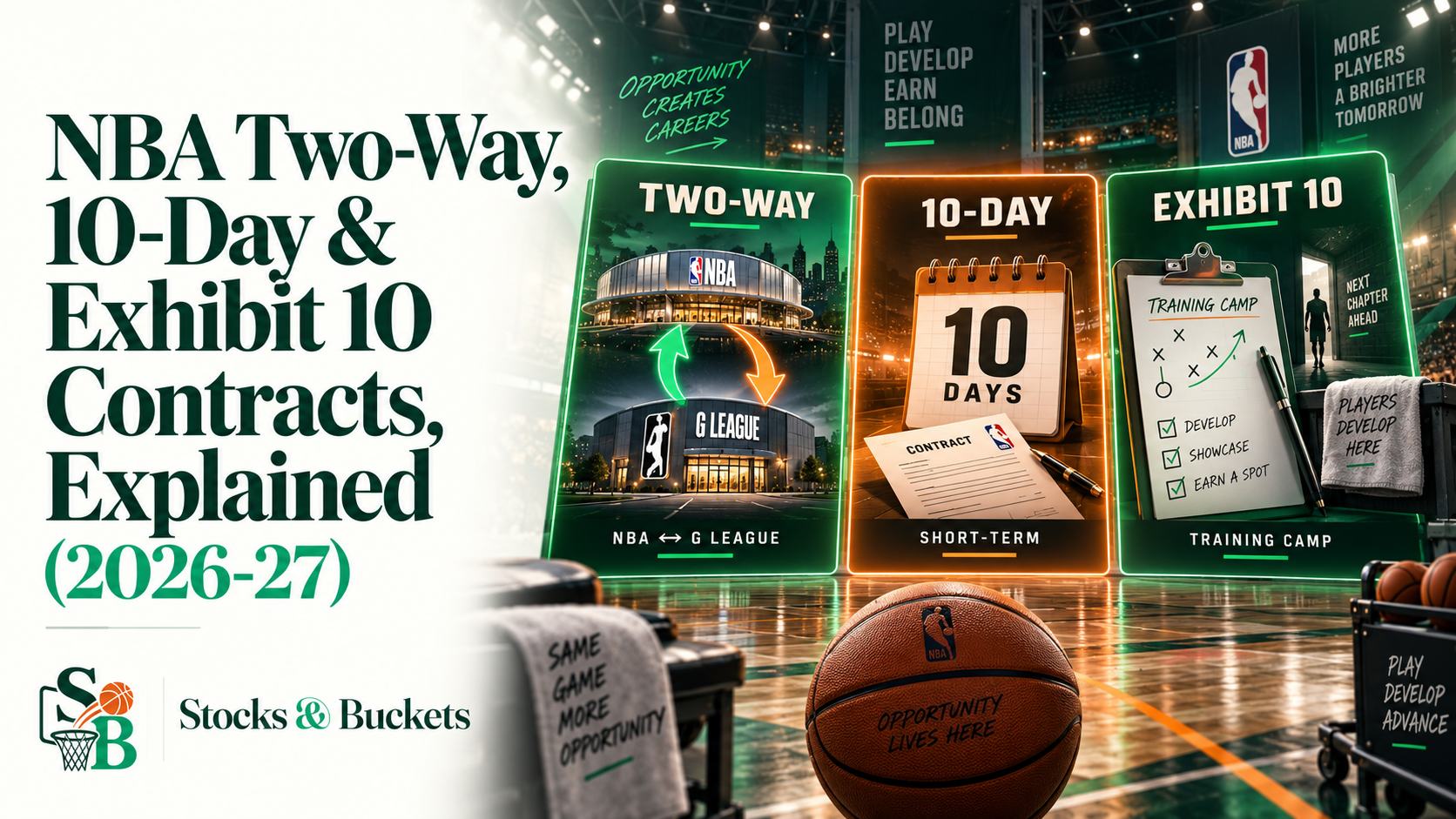
Part of The Cap Sheet — our series decoding how NBA front offices actually work. Start with the overview: How the NBA Salary Cap Works, then the money lines in the luxury tax & aprons deep dive.
We've spent this series at the top of the payroll — the maxes, the tax, the aprons where dynasties go to die. Now we finish at the bottom of the roster, and it turns out that's where a surprising amount of hidden value lives. The last few contract slots on every team are cheap, flexible, and strange, and they're exactly how the league turns undrafted names into rotation players.
For a fantasy manager, that matters more than it sounds. The names on these deals are the deep-league waiver pool — the guys nobody drafts who suddenly log 30 minutes when a starter tweaks an ankle. Learn to read the bottom of the roster and you'll spot a streamer a week before your leaguemates even know his name. Let's decode it.
Two-way contracts: the developmental fast lane
A two-way contract is a deal that lets a player bounce between the NBA team and its G-League affiliate — the "two ways" being the two levels he can be paid to play at. It's built for prospects who aren't quite rotation-ready but are too good to lose, and it's the single most important contract at the bottom of the roster.
The rules are specific, and every one of them shapes how you should think about the player:
| Two-way rule | 2026-27 detail | Why it matters |
|---|---|---|
| Slots per team | Up to 3 | Every team has three of these lottery tickets to hand out. |
| Salary | About $679K (half the rookie minimum) | Dirt cheap — and it does not count against the salary cap. |
| NBA game cap | Active for roughly 50 NBA games | He physically can't play a full season up top without a conversion. |
| Playoff eligibility | Not eligible unless converted | Come playoff time, a two-way guy is on the outside looking in. |
| Roster count | Sits outside the standard 15 | A two-way doesn't use one of the 15 guaranteed spots. |
Read that game cap twice, because it's the fantasy tell. A two-way player can appear for about 50 NBA games — so a team managing that limit will shuttle him to the G-League on quiet nights and call him up when the schedule or the injury report demands it. When his NBA availability lines up with an opening in the rotation, you get a burst of usable minutes on a near-free contract.
The escape hatch is conversion: a team can promote a two-way player onto a standard contract, which uncaps his games, makes him playoff-eligible, and moves him into one of the 15 roster spots. A conversion is a loud signal — it means the team has decided this guy is a real NBA player, now. Undrafted success stories like Austin Reaves and Fred VanVleet are the archetype here: two-way or minimum-deal afterthoughts who played their way into standard contracts and then into real fantasy relevance. When you see "converted from his two-way," read it as a green light.
10-day contracts: the mid-season audition
A 10-day contract is exactly what it sounds like — a short deal, at the prorated minimum, that teams can hand out from January onward to plug a temporary hole (injuries, a COVID-style absence, a brutal back-to-back stretch). It's a tryout with a paycheck.
There's one rule that makes 10-days easy to read, and it's the one people forget:
A player can sign at most two 10-day contracts with the same team in a season. After the second one, the team must either sign him for the rest of the season or let him walk.
So a 10-day is really a two-strike audition. First 10-day: prove you belong. Second 10-day: prove it again. After that, the team is forced to make a real decision — commit for the season or move on. That built-in deadline is why a 10-day guy's role can jump suddenly: once he's signed for the rest of the year, the team has skin in the game and tends to actually play him.
The fantasy version of this is simple. A player on his first 10-day is a flier. A player who just got signed for the rest of the season off a strong audition is a team telling you, in writing, that they trust his minutes.
The Exhibit 10: the on-ramp
An Exhibit 10 isn't really its own contract type — it's a clause bolted onto a one-year, non-guaranteed minimum deal, which is why you'll hear it called a training-camp contract. It does two clever things at once:
- It can convert into a two-way. A team can bring a player to camp on an Exhibit 10 and, if he impresses, flip that deal into one of its three two-way slots — no extra negotiation needed.
- It carries a small G-League bonus. If the team instead waives him and he then reports to the team's G-League affiliate, he collects a bonus of up to about $85K. That's the incentive that keeps a cut player in the organization's orbit instead of chasing an offer elsewhere.
Put those together and the Exhibit 10 is the league's on-ramp for undrafted players. Come to camp cheap and non-guaranteed; earn a two-way and you're on the NBA ladder; get cut and you still bank a bonus for staying in the system, where the next injury call-up might find you. It's how a name like Fred VanVleet goes from undrafted to indispensable — the door is narrow, but it exists, and it starts here.
Draft-and-stash: the player you already own
Not every prospect a team controls is even in the building. A draft-and-stash is a player — usually a second-round pick or an international prospect — that a team drafts and then deliberately leaves overseas to keep developing on someone else's dime. The team retains his NBA rights until he decides to come over, so he stays off the roster and off the books for now.
It's the patient man's roster move: no salary, no roster spot, no rush, and a ready-made prospect waiting in the wings. The all-time advertisement for drafting late is Nikola Jokić — a 41st pick, taken during a Taco Bell commercial, who became a three-time MVP. Second-round gems like Jalen Brunson tell the same story: the bottom of the draft is not the bottom of the talent pool. For fantasy, a stashed player is a name to file away — irrelevant today, potentially a sleeper the season he finally crosses the Atlantic.
Quick recap: cap holds & renouncing
One more piece ties the bottom of the roster back to the money lines. Even the players a team isn't paying yet can occupy cap space, through cap holds — placeholder charges the league keeps on the books for a team's own free agents and for every empty roster spot below the minimum. (We went deep on these in the free-agency piece.)
To turn those holds into usable money, a team renounces the player — formally giving up the right to re-sign him over the cap, which also surrenders his associated Bird rights. The relevance here: filling out the back of a roster with cheap two-way and minimum deals is often how a team stays flexible after it has renounced its way to cap room. Cheap bodies keep the roster legal without eating the space the front office just worked to clear.
Cap-speak, translated
Keep this near the transactions wire:
| Phrase | What it really means |
|---|---|
| "He's on a two-way" | Cheap (~$679K), splits time with the G-League, capped near 50 NBA games, not playoff-eligible yet |
| "They converted his two-way" | Promoted to a standard deal — uncapped games, playoff-eligible, a real roster spot. A vote of confidence |
| "He signed a 10-day" | A short mid-season audition; two max with one team before they must commit or cut |
| "Signed for the rest of the season" | The audition worked — the team is committing minutes, not just kicking tires |
| "He's an Exhibit 10 guy" | Camp invite on a non-guaranteed minimum; can become a two-way, or a G-League bonus if waived |
| "They drafted and stashed him" | A pick left overseas to develop; the team holds his rights with zero cost today |
Why the bottom of the roster is a fantasy goldmine
Here's the payoff, and it's the whole reason to care about contracts nobody talks about: the deep-roster names are the streamer and waiver pool in any league with real depth. In a 12- or 14-team format, the difference between a good week and a bad one is often a single hot pickup — and that pickup is frequently a two-way or 10-day player who just walked into minutes.
The mechanism is always the same. A starter goes down, the rotation compresses, and the next warm body inherits real run overnight:
- A two-way player gets recalled the same week a wing goes down → suddenly he's playing 28 minutes and stuffing a box score, on a contract that costs less than a veteran's meal money.
- A 10-day audition turns into a rest-of-season deal → the team just told you it trusts his minutes. That's your cue, not your leaguemate's.
- An Exhibit 10 guy sticks out of camp → a training-camp afterthought is now a rotation piece before the projection market has repriced him.
That last mile — a roster move today becoming a minutes-and-usage change tomorrow — is exactly what our engine is built to catch. When a call-up or a conversion opens a runway, we re-project everyone it touches: new role, new minutes, new category value, so you're drafting and streaming the current depth chart, not last month's. See where every player lands on our live projections board, and if you're chasing a punt build, our guide to punt builds shows how a cheap two-way specialist — a shot-blocker, a steals menace — can quietly win you a category.
And that's the whole Cap Sheet. You started at the salary cap, climbed through the tax and the two aprons, and walked through free agency, Bird rights, contracts, and trades — finishing here at the last three slots on the bench. Put it together and you can read any front-office move — a blockbuster, a salary dump, a random Tuesday call-up — and know exactly what's happening and, more importantly, who's about to get minutes. That's the edge we came for. Thanks for reading.
Quick answers about two-way and 10-day contracts
What is a two-way contract in the NBA?
A deal that lets a player split time between an NBA team and its G-League affiliate. A team can carry up to three, each pays about $679K (roughly half the rookie minimum), the player can be active for around 50 NBA games, and he isn't playoff-eligible unless the team converts him to a standard contract. Two-way salary doesn't count against the salary cap.
How does a 10-day contract work?
It's a short prorated-minimum deal teams can use from January on to fill a temporary hole. A player can sign at most two 10-days with the same team in a season — then the team must either sign him for the rest of the season or let him go.
What is an Exhibit 10 contract?
A one-year, non-guaranteed minimum (training-camp) deal. It can convert into a two-way, and it carries a small bonus (up to about $85K) if the player is waived and then spends time with the team's G-League affiliate. It's a common on-ramp for undrafted players.
What is a draft-and-stash player?
A player — usually a second-rounder or an international prospect — a team drafts but leaves overseas to keep developing. The team retains his NBA rights until he comes over, so he stays off the roster and off the books for now.
Why do two-way and 10-day players matter for fantasy?
They're the deep-league waiver pool. When injuries hit, a two-way or 10-day player can inherit real minutes overnight, turning a name nobody rostered into a streamable source of counting stats before the market reprices him.
Did the bottom-of-the-roster contracts finally make sense?
That's the full Cap Sheet — you can now read any front-office move like a GM. Figures reflect the NBA's official 2026-27 cap; mechanics follow the 2023 Collective Bargaining Agreement. New here? Here's who we are and how we think about the game.
New analysis, every week.
Our sharpest reads and the views we'd act on, plus early access to the tools.
Join us