

NBA Trade Exceptions, Sign-and-Trades & the Stretch Provision (2026-27)
NBA trade exception, explained: how a TPE is created and its one-year clock, plus sign-and-trades, the poison pill provision, dead money and the stretch provision.

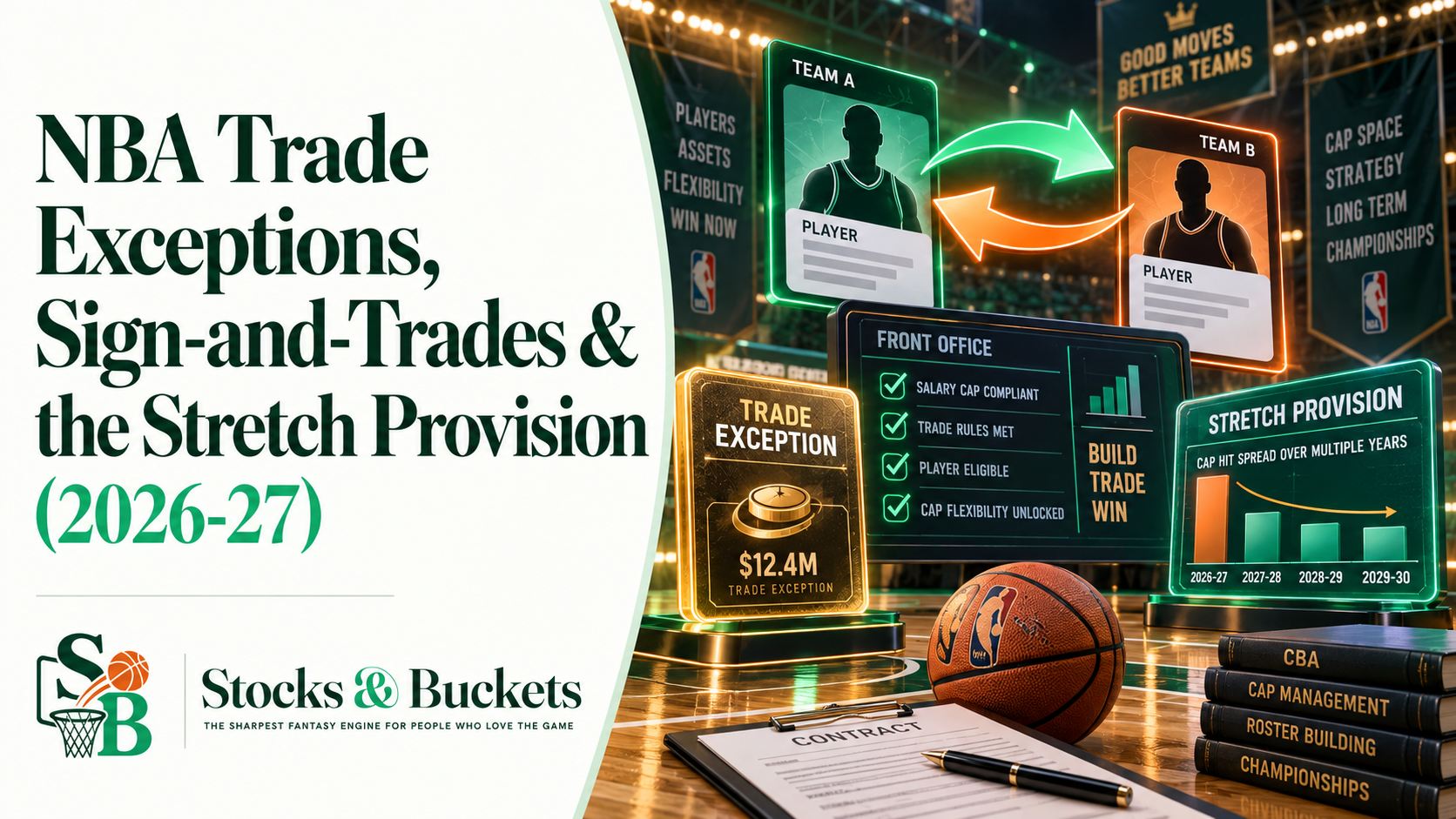
Part of The Cap Sheet — our series decoding how NBA front offices actually work. Start with the overview: How the NBA Salary Cap Works, then the money lines in the luxury tax & aprons deep dive.
Some transactions make no sense until you read the fine print. A team trades away a useful player and takes back… nothing. A star "leaves" in free agency but his old team somehow gets three players and a pick. A veteran is waived in October and still counts against the cap two years later. None of that is a mistake — it's the machinery in this article working exactly as designed.
This is the plumbing beneath the trade market: the traded player exception, the sign-and-trade, the poison pill provision, and the dead money rules that let teams waive expensive players without the full hit landing at once. Learn these four and the weirdest moves on your feed stop being weird.
The traded player exception: taking back nothing, on purpose
Start with the one that confuses everyone. As we cover in how the salary cap works, an over-the-cap team's outgoing and incoming salaries have to roughly match. But a trade doesn't have to happen all at once. When a team sends out a salary and takes back less — or nothing — the league lets it bank the difference as a traded player exception (TPE), sometimes just called a "trade exception."
Think of it as a salary-shaped gift card. Trade away a $12M player for a future second-round pick and no salary coming back, and the team walks away with a $12M TPE: a slot it can use later to absorb one incoming contract without sending out matching money. A handful of rules define it, and they all matter:
| Rule | What it means |
|---|---|
| Size | Equal to the salary gap you created (outgoing minus incoming) |
| Clock | Good for one year from the day the trade is completed — use it or lose it |
| One player | Absorbs exactly one incoming contract that fits under the slot; you can't split it across two players |
| No combining | Can't be stacked with other salary or another exception to chase a bigger target |
That last rule is the killer. A $12M TPE can absorb a $12M player, but it can't be added to a $10M expiring contract to chase a $22M star — a TPE stands alone. And second-apron teams effectively can't create or use them the normal way, one more tool the second apron quietly removes.
A worked example
Say a team trades Damian Lillard — carrying a $48M salary for the sake of round numbers — and, in a non-simultaneous deal, takes back only draft picks and a $6M young player.
- Outgoing salary: $48M
- Incoming salary: $6M
- TPE created: $48M − $6M = $42M
For the next 12 months, that team holds a $42M slot. It can use it to absorb one player earning up to about $42M without sending out a dime of matching salary — a huge advantage if a rival is dumping money. But if nobody fitting comes along inside a year, the slot simply expires. Teams generate these deliberately, then shop them like currency at the deadline.
Sign-and-trades: leaving for nothing, minus the "nothing"
Now the move that makes stars "leave" while their old team still cashes out. Normally a free agent who signs elsewhere brings his old team nothing — no assets, just an empty roster spot. The sign-and-trade (S&T) fixes that for both sides at once.
Here's the mechanic: the player's own team re-signs him and, in the same motion, trades him to the team he actually wants. Why bother? Because the incumbent can offer a bigger, longer deal — up to four years — than an outside team can, and doing it as a trade means the old team gets assets back (players, picks) instead of watching him walk for free. Everybody clears something: the player gets the fatter contract, the new team gets its guy, the old team gets a return.
But the league attaches a serious tax to the team acquiring the player:
| Restriction | Who it hits |
|---|---|
| Hard cap at the first apron | The team acquiring the player via S&T is hard-capped at the first apron ($209.015M in 2026-27) for the rest of the season — a wall it cannot cross for any reason |
| Second-apron ban | A team already over the second apron ($221.686M) cannot acquire a player by sign-and-trade at all — the door is fully shut |
That's why you'll hear "they can't do a sign-and-trade for him — they're already over the second apron." It isn't posturing; the mechanism literally forbids it. A contender chasing a max free agent like Paul George or Kawhi Leonard has to check its apron math first, because accepting that salary can slam a hard ceiling onto its whole season.
The poison pill provision: too valuable to trade
This one sounds like a trick and is really just an accounting quirk with sharp teeth. When a young player signs a rookie-scale extension — a new deal layered onto his rookie contract — there's a window where the two sides of a potential trade count his salary differently.
- The team sending him out counts a lower number (roughly his old, pre-extension figure).
- The team taking him in counts the higher number (the average of the big new extension).
Because trades have to match salary, that mismatch is poison: the incoming team absorbs a large figure while the outgoing team only "sheds" a small one, so the math almost never works. A recently extended young star — picture a rising two-way big along the lines of Victor Wembanyama just after signing — becomes temporarily untradeable, not because nobody wants him but because the cap arithmetic briefly refuses to cooperate. It's the league's way of stopping teams from extending a player and flipping him the same week.
Dead money and the stretch provision
Last stop, and the one that explains ghosts on the cap sheet. When a team waives a player who still has guaranteed money owed, that salary doesn't vanish — it becomes dead money: cap charge for a player who no longer plays for you. He's gone; his number stays.
Teams have two ways to eat it. Take the whole hit in the seasons it was already scheduled, or invoke the stretch provision — spread the remaining guaranteed money over twice the remaining years, plus one. That formula is the whole trick:
| Years left on the deal when waived | Stretched over |
|---|---|
| 1 year | 3 years (2×1 + 1) |
| 2 years | 5 years (2×2 + 1) |
| 3 years | 7 years (2×3 + 1) |
A worked example
Say a team waives a veteran with one year and $15M guaranteed left, and it wants the smallest possible annual hit.
- Without stretching: the full $15M counts this season — a big, awkward chunk of dead money.
- With the stretch: 1 year left → spread over 3 seasons → $15M ÷ 3 = $5M per year for three years.
Same total paid out, but the cap charge drops from $15M in one year to $5M across three — often the difference between ducking a luxury-tax bracket and blowing past it. This is the "waived-and-stretched" you hear about; John Wall's famous buyout-era exit is the classic version of a big contract cleared off the books this way. The tradeoff is honest: you buy relief now by carrying a small dead-money charge for years, which can clog future flexibility.
Cap-speak, translated
Keep this next to the trade tracker:
| Phrase | What it really means |
|---|---|
| "They created a trade exception" | They took back less salary than they sent, banking a one-year slot to absorb a player later |
| "They used their TPE" | They absorbed one incoming contract into that slot without sending out matching money |
| "It has to be a sign-and-trade" | His old team is re-signing him just to trade him, so it gets assets and he gets a bigger deal |
| "That hard-caps them at the first apron" | Acquiring via S&T (among other tools) built a hard ceiling for the season |
| "He's basically untradeable right now" | The poison pill — a rookie-scale extension makes both teams count his salary differently |
| "They waived and stretched him" | They spread his guaranteed dead money over twice the remaining years plus one |
What the fine print opens up for fantasy
Every mechanism here is, underneath, a minutes event — and minutes are where fantasy value is quietly born:
- A stretched or waived veteran doesn't just clear cap; he clears a roster spot and a role. The younger player behind him inherits real minutes, and that's a late-round breakout the box score hasn't priced yet.
- A TPE lets a contender quietly absorb one useful rotation player for spare parts. That player often lands somewhere with a clearer path than he had — a buy-low with a new runway — while someone on the new team gets nudged down the depth chart.
- A sign-and-trade reshuffles two rotations at once. Projected minutes move on both rosters, usually before the fantasy market catches up.
That last mile — a cap move today becoming a role-and-usage change tomorrow — is exactly what our engine is built to catch. When a domino falls, we re-project everyone it touches: new role, new minutes, new category value, so you're drafting the new reality instead of last month's depth chart. See where every player lands on our live projections board, and if you're turning a cap-driven bargain into a matchup edge, our guide to punt builds shows how to weaponize it.
So next time a rotation vet gets "waived and stretched" or a contender uses a mystery trade exception, read it like a GM: someone's minutes just opened up, and someone behind him is about to eat. Spot it a step before your league does — that's the edge.
Quick answers about trade exceptions and the fine print
What is a traded player exception (TPE) in the NBA?
A trade exception is a salary "slot" a team earns when it trades a player away and takes back less money than it sent out. It equals the gap, lasts one year, and lets the team later absorb one incoming player with no matching salary going out. It can't be combined with other money or another exception.
Why do NBA teams do sign-and-trades?
Because a player's own team can offer a bigger, longer deal — up to four years — than an outside team can, and structuring the exit as a trade means the old team gets assets instead of nothing. The cost: the acquiring team is hard-capped at the first apron, and a team over the second apron can't do one at all.
What is the poison pill provision?
After a player signs a rookie-scale extension, the two teams in a trade count his salary differently — the outgoing team uses a lower number, the incoming team the higher extended average. The mismatch makes the salary-matching math fail, so he's briefly very hard to trade.
What is the stretch provision?
When a team waives a player with guaranteed money left, it can spread that dead money over twice the remaining years plus one — a final $15M year becomes roughly $5M across three seasons, shrinking the annual cap hit.
What is dead money?
Guaranteed salary a team still owes a player it already waived. He's off the roster, but the money keeps counting against the cap until it's paid — all at once, or stretched across extra seasons.
Did the trade exception and stretch provision finally make sense?
Next in The Cap Sheet: the roster edges — two-way deals, 10-days and the Exhibit 10. Figures reflect the NBA's official 2026-27 cap; mechanics follow the 2023 Collective Bargaining Agreement. New here? Here's who we are and how we think about the game.
New analysis, every week.
Our sharpest reads and the views we'd act on, plus early access to the tools.
Join us