

How the NBA Salary Cap Works, Explained Simply
How the NBA salary cap actually works — the soft cap, exceptions, max contracts, the luxury tax, and the two aprons — explained in plain English, with the fantasy angle.

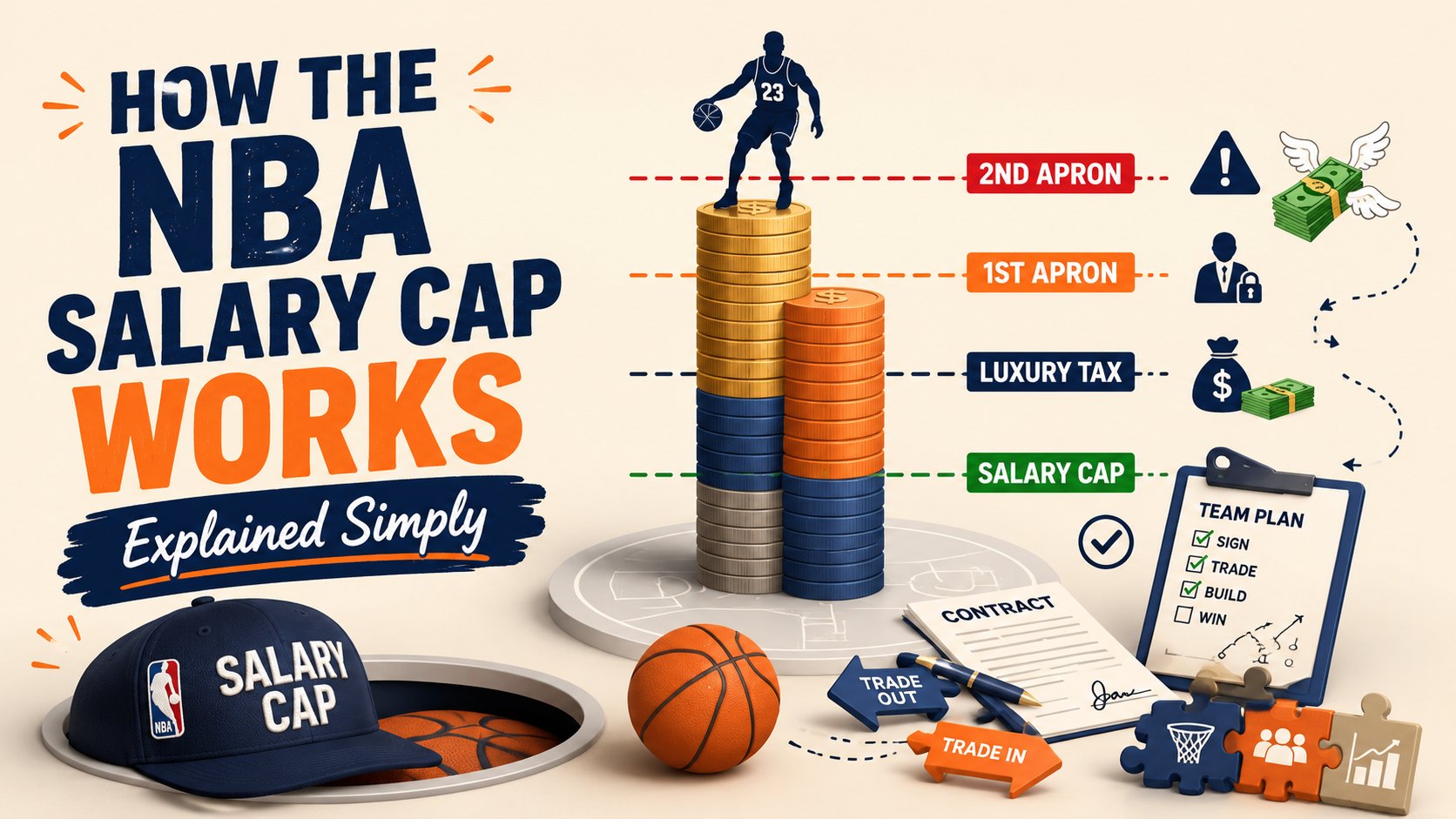
NBA summer is here — and what a summer it's been. Trade season and free agency have handed us an absolutely ridiculous run of blockbusters, with stars swapping jerseys faster than you can update your depth charts. It's been a genuine treat if you love this stuff as much as we do.
But if you've watched it all unfold and thought, wait — why would they trade him?, you're asking the right question. And the answer, more often than not, comes down to two words: the cap. A team ships out a productive player for spare parts, or lets a good starter walk for nothing, and the reason is almost never talent — it's the NBA's salary rules. Understand those rules and the whole offseason stops looking random. It also, it turns out, tells you a lot about where fantasy value is about to move.
So let's demystify it. No law degree required.
What the salary cap is
The NBA sets a limit on how much each team can spend on player salaries in a season — the salary cap. That number isn't arbitrary: it's tied directly to how much money the league makes. Players and owners split "basketball related income" (ticket sales, TV deals, merch, all of it) roughly down the middle, and the cap is essentially that players' share divided across the 30 teams.
The practical upshot: when league revenue jumps, the cap jumps. With the NBA's massive new media deal kicking in, the cap is rising near its maximum allowed pace — which is why max contracts and role-player deals both look bigger every year. When you hear a contract is "worth 25% of the cap," that's the anchor everything is measured against.
The twist: it's a soft cap
Here's the part that confuses everyone. If there's a spending limit, why are almost all 30 teams over it?
Because the NBA has a soft cap — a limit with a bunch of legal ways around it. The league built in loopholes (officially, "exceptions") on purpose, mostly so teams can afford to keep their own stars. A hard cap would force great teams to break themselves up the moment a young player got expensive. The soft cap says: you can go over the line, as long as you're doing it through an approved exception.
The big exceptions worth knowing:
- Bird rights. A team can re-sign its own free agent for almost any amount, even if that pushes it way over the cap. This is the single most important rule for keeping teams together — it's why your favorite team can pay its homegrown star the max without needing cap "room."
- The Mid-Level Exception (MLE). Even a team already over the cap gets one set chunk of money each year to sign an outside free agent. It's how contenders add a useful rotation piece without any cap space.
- Minimum contracts. Any team can always sign a player to a league-minimum deal. It's how veterans on the buyout market land on good teams late.
We'll go deeper on how free agency and these exceptions actually play out in a follow-up — for now, the key idea is: over the cap ≠ can't sign anyone.
Max contracts: the ceiling on a single player
The flip side of the cap is a limit on any one player's salary. A max contract is capped as a percentage of the cap, and it scales with experience:
- about 25% of the cap for younger players (roughly 0–6 years in the league),
- about 30% for mid-career players (7–9 years),
- about 35% for veterans (10+ years).
(There's a bump — often called the "supermax" — for homegrown stars like Nikola Jokić or Giannis Antetokounmpo who hit big All-NBA or MVP honors on their own team.) This is why a superstar's deal is described as a percentage, not just a dollar figure: as the cap climbs, so does the max.
The luxury tax: a second, scarier line
Above the cap sits a higher threshold: the luxury tax line. Spend past it and you don't just pay your players — you also pay a penalty tax to the league, on a sliding scale that gets steeper the further over you go. Teams that pay it year after year get hit with an even harsher repeater rate.
The tax is why a profitable, winning team will sometimes still dump a useful player: crossing (or staying over) that line gets expensive fast, and not every owner is willing to eat it.
The two aprons: the new hard(ish) ceilings
The rule that's reshaped the league most recently is the apron system — two thresholds above the luxury tax, each with escalating restrictions on team-building. (We break down the exact figures, the tax math, and every restriction in the deep dive.) Blow past the second apron and the penalties get genuinely punishing: you can't combine salaries in trades, you lose access to your mid-level exception, and future draft picks can get frozen or shipped to the back of the line.
Translation: the biggest-spending teams are now boxed in. They can't easily improve, and keeping an expensive roster together comes with real roster-building handcuffs. This is the single biggest reason you've seen contending teams break up stars they'd normally never move. When a blockbuster looks like a team giving away a good player, the apron is usually the invisible hand.
Why any of this matters for fantasy
Here's where it comes home. The cap, the tax, and the aprons are the machinery that decides which players get traded, kept, or cut — and every one of those moves changes minutes, roles, and usage. And minutes and usage are fantasy value.
- A team ducking the second apron trades a starter → someone behind him inherits the minutes and the shots. That's a fantasy riser, often before the market notices.
- A tax team waives a veteran to save money → a cheaper young player gets the runway to break out.
- A star gets moved for cap reasons — a Kevin Durant-level name changing teams → both rosters re-shuffle, and the projected lineups shift on both ends of the deal.
That's exactly the kind of ripple our engine is built to price in the moment it happens. When a cap-driven move drops, we re-project the players it touches — new role, new minutes, new category value — so you're acting on the new reality, not last month's depth chart. You can see where every player lands on our live projections board, updated as the news breaks.
So the next time a trade makes you say "why would they do that?", check the cap sheet before you check the box score. The answer's usually there — and the fantasy edge is in seeing the consequence a step earlier than your league.
We kept this simple — the deep version exists
This was the plain-English tour: enough to read the offseason and understand why the dominoes fall. You asked for the rabbit hole, and we're mapping it — this is the hub of The Cap Sheet, our series decoding how front offices actually work.
First deep dive, live now: The NBA Luxury Tax & Two Aprons, Explained — the exact 2026-27 numbers, the tax-bracket math (with worked examples), and precisely which roster tools each apron takes away. Up next: how free agency really works, Bird rights and the exceptions, and how trades get done.
Quick answers about the NBA salary cap
How does the NBA salary cap work?
The cap is a team spending limit tied to league revenue — the players' share of basketball-related income, divided across the 30 teams. But it's a soft cap: teams can spend past it through built-in exceptions like Bird rights and the mid-level exception, which is why nearly every team sits over the line.
Why are almost all NBA teams over the salary cap?
Because it's a soft cap by design. The league left legal ways around the limit — exceptions — mostly so teams can afford to re-sign their own stars. Over the cap ≠ can't sign anyone; it just means signing through exceptions instead of open room.
What is a max contract in the NBA?
A limit on any one player's salary, set as a percentage of the cap that scales with experience — roughly 25% for younger players, 30% mid-career, and 35% for 10-plus-year veterans. A "supermax" bump exists for players who earn major honors with their own team.
What is the NBA luxury tax?
A second, higher line above the cap. Cross it and you pay a penalty tax on a sliding scale that steepens the deeper you go, with a harsher "repeater" rate for teams that pay year after year. We break down the exact math in the deep dive.
What are the two aprons?
Two thresholds above the tax, each with escalating team-building restrictions. Cross the second apron and you can't aggregate salaries in trades, lose your mid-level exception, and can have future first-round picks frozen — which is why the biggest spenders are now the most boxed-in.
Want us to go deeper on the technical side of the NBA salary cap?
New around here? Here's who we are and how we think about the game.
New analysis, every week.
Our sharpest reads and the views we'd act on, plus early access to the tools.
Join us